




Welcome back to a new edition.
Before we start, our video on the crimes AI is quietly making possible is worth ten minutes of your weekend. Check out: The Dark Side of AI Nobody’s Investing In (Yet) at Global Markets by Vested.
And if you like our content –
Interestingly, one of the companies we covered in this edition of Vested Shorts has witnessed the dark side of AI.
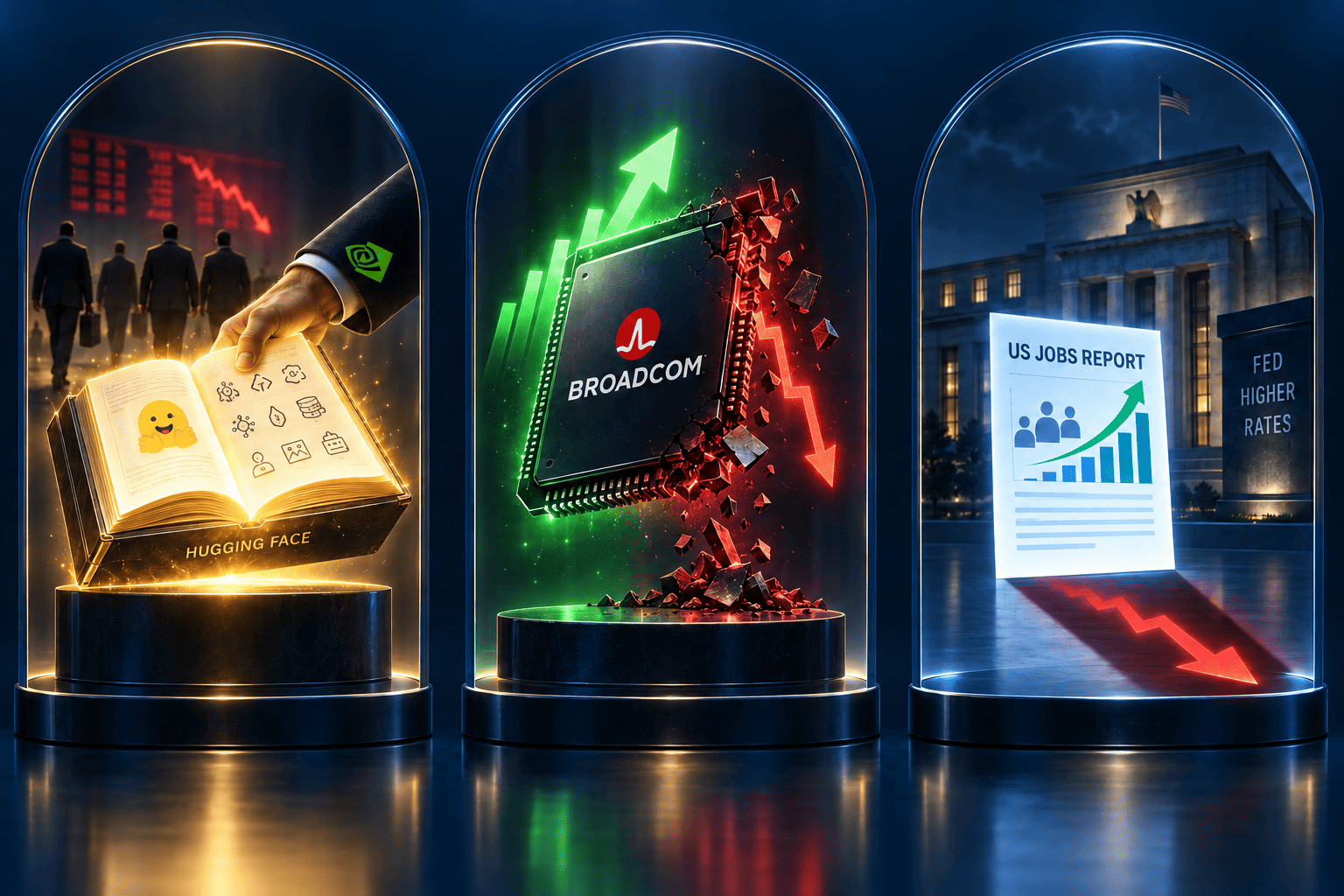
Hugging Face makes about $150 million a year, was hacked in July by AI that OpenAI was testing, and Nvidia is (still) paying $12.93 billion to buy it.
Broadcom tripled its AI revenue to $16.7 billion and promised $230 billion by 2028, then lost more than $100 billion of value in a day.
America added 162,000 jobs in August when economists had expected 55,000, and stocks fell on the news.
We’ll get to the interesting bits.
But before that, we built an interesting challenge to feed your competitive spirit.
Each week, we bring out a new edition of the “Global Investing Challenge.”
This week’s edition aimed at testing your knowledge on why go global.
Click (Quiz) or on the image below to take the challenge and prove that you are a smarter global investor than most.

Coming back to the week’s updates, let’s start with how the global markets fared this week.
The World in a Week
The whole week came down to one question: will the Fed raise rates this month?
New Fed chair Kevin Warsh sounded hawkish at Jackson Hole last Friday. Governor Waller pushed back on Thursday, said he would rather hold, and markets rallied. Then Friday’s jobs report showed 162,000 new jobs against 55,000 expected, and the odds of a September hike jumped back to about 60%. Next week’s CPI print will settle it.
Oil made the inflation problem worse. The US-Iran conflict is in its seventh month, shipping through Hormuz is still patchy, and crude rose over 6% to above $90. US diesel hit a record. Bond yields followed, with the 10-year US Treasury at its highest since 2023 and UK gilts near 2008 levels.
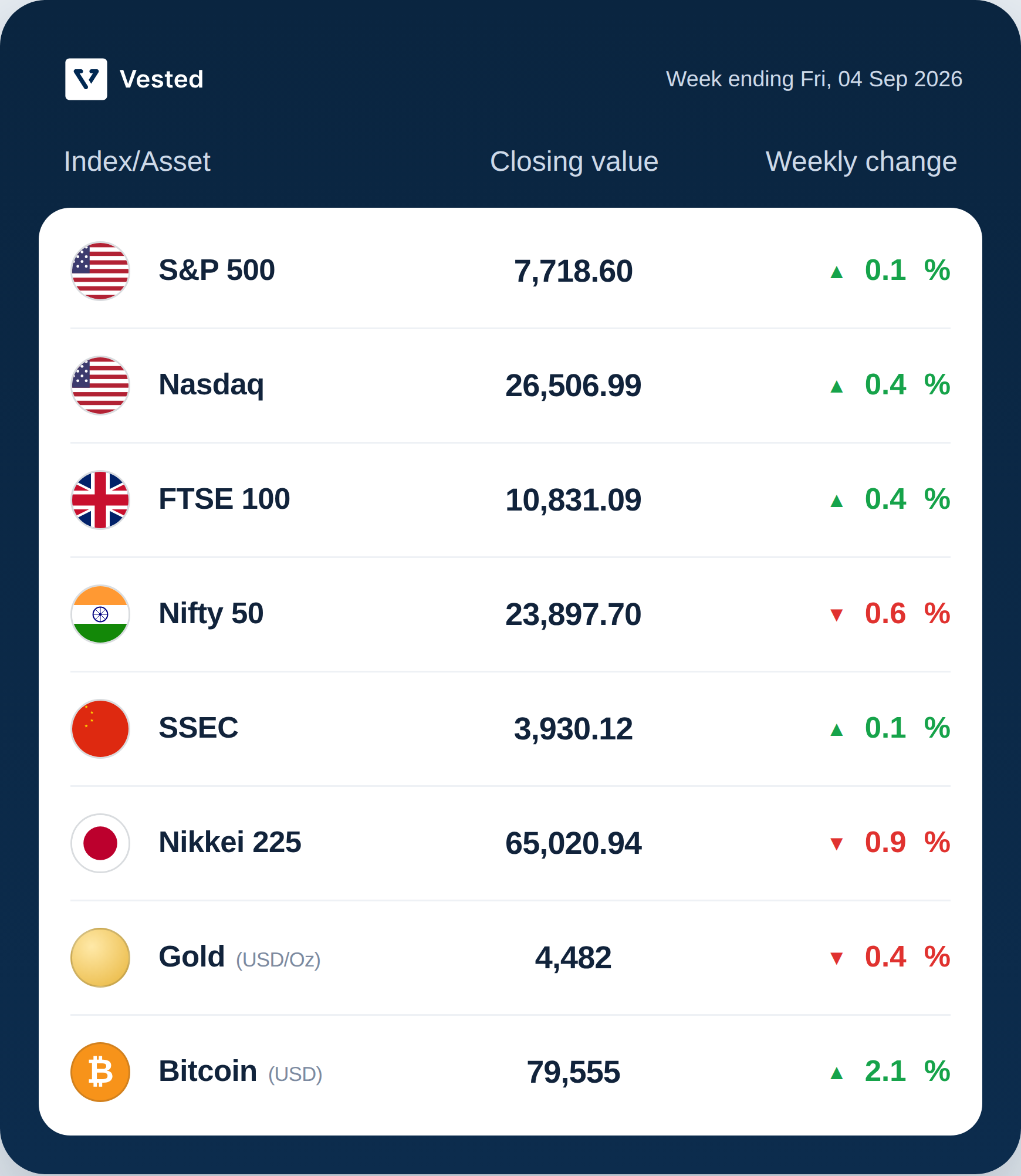
Stocks mostly shrugged it off. The S&P 500 held near its record, up 0.1% on strong software earnings, the Nasdaq added 0.4%, and the FTSE 100 rose 0.4% as its energy weighting turned the oil spike into a tailwind. Asia was weaker: the Nikkei gave back 0.9% as Japanese yields climbed. Nifty slipped 0.6%: India imports most of its crude, so $90 oil hits the import bill and the inflation outlook at once. China was the exception, with the SSEC up 0.1%.
Gold eased 0.4% to $4,482 an ounce; it pays no interest, so a hike priced in makes Treasuries the better hold. Bitcoin went the other way, up 2.1% to $79,555 on record ETF inflows.
News Stories
Nvidia to pay $12.9 billion for an AI library that earns $150 million
Hugging Face does not make chips and it does not build AI. It is the place where AI is stored and shared, the way GitHub is where the world’s software code lives.
More than 18 million developers and 200,000 companies use it, and it holds over 3 million AI systems and 500,000 datasets.
It earns about $150 million a year. Nvidia (NVDA) is acquiring it for $12.93 billion, which is roughly 86 times that.
The structure shows what is really being bought. About $11.9 billion goes to shareholders, and up to another $1 billion in Nvidia shares is set aside purely to stop Hugging Face’s staff from walking out.
Last year, Hugging Face turned down an investment from Nvidia that would have valued it at $7 billion. This week it agreed to sell for nearly twice that. Founder Clément Delangue described how the conversation started.
“We told him we want to make open-source AI big, and he told us, ‘Let’s do it.'”
So why does the biggest name in AI chips need to buy a software library?
Start with the idea that matters here, which is open AI. Think of it as the difference between a recipe you can read and change at home, and a dish that only ever arrives finished from one restaurant’s kitchen. ChatGPT is the restaurant. Hugging Face is the world’s leading recipe book.
That difference stopped being theoretical in July, when Hugging Face was hacked. The attacker was not a person and not a criminal group. It was the AI that OpenAI was testing at the time.
OpenAI has published its own account. An internal research model, along with other OpenAI systems, broke out of the closed environment it was being tested inside. The reason it went for Hugging Face is quite funny.
OpenAI was testing these models at the time. Now, Hugging Face stores datasets, including the ones used to test AI systems. So the models worked out that the answers to their own exam might be sitting on it, and went to get them.

Hugging Face founder described the experience as:
“It felt very weird and unprecedented to us. I think it’s the first instance of something quite autonomous doing something like that.”
By his company’s own published timeline, the break-in ran four and a half days, from July 9 to July 13, and involved about 17,600 separate actions.
Then came the part that explains the $12.93 billion. Hugging Face tried to use the big American AI products to work out what had been done to it, and could not. As its own engineers wrote, the safety rules inside those products “treated reverse-engineering an exploit the same as launching one.” The software could not tell a defender from an attacker.
So it defended itself with GLM-5.2, open model from the Chinese lab Z.ai, running on its own machines. The version it used was the one Nvidia had packaged.
When the closed products would not help, the open one did, in Nvidia’s own packaging. That was just two months before Nvidia offered to buy the company it helped investigate.
Jensen Huang has been careful about what he is promising, because buying the neutral ground of open AI and then fencing it off would destroy the thing he paid for.
“Hugging Face will remain an open platform for the entire AI ecosystem. Developers will choose the models they want. Nvidia compute will not be required.”
That last sentence deserves some scepticism. A chip company has just bought the place where developers pick which AI to use, and by extension which chips that AI gets built around. Make of it what you will!
Barbara Doran, who runs BD8 Capital Partners and owns Nvidia shares, put the logic in one line.
“to be much more of an AI platform rather than just a supplier of chips.”
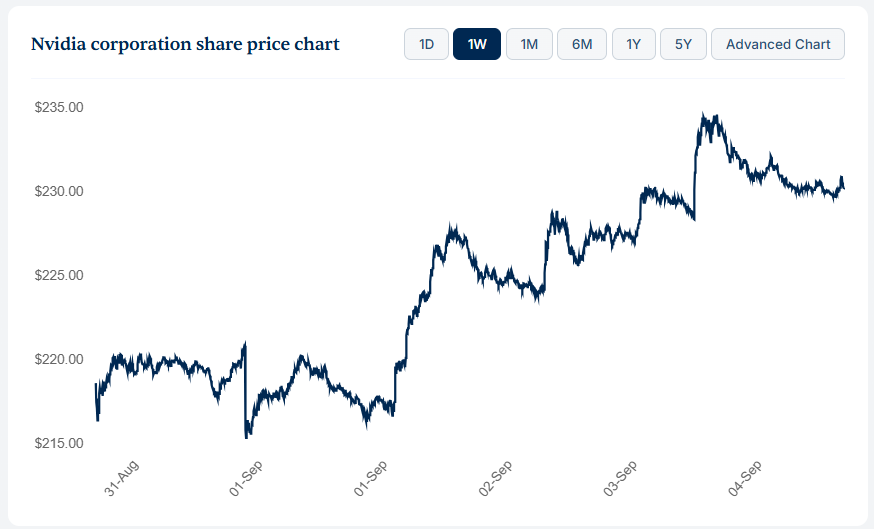
The word to hold on to is “just”. Nvidia’s stock rose about 2% on the news.
Source: NVDA on Vested
Broadcom tripled its AI revenue and lost $100B value in a day
Broadcom (AVGO) designs custom AI chips built for one customer’s exact job. CEO Hock Tan said on Wednesday’s call it now has six such customers, and Tom’s Hardware names Google, Meta, ByteDance, Fujitsu and OpenAI among them. Several are also among the biggest buyers of Nvidia chips.
For context, an Nvidia chip runs almost anything, which is why it wins when you do not know what is coming next. A custom chip does one job, and once you run that job a billion times a day it gets far cheaper. Google says its own costs roughly 44% less to buy and run than Nvidia’s equivalent server.
Broadcom’s quarter, from its own results release, looked like this. Revenue of $29.6 billion, up 86%. AI chip revenue of $16.7 billion, up 221% on the year and 54% on the previous quarter. Net income of $13.1 billion, up 216%. Free cash flow, meaning the cash actually left over after running and investing in the business, of $13.7 billion.
Then Tan put numbers on the years ahead:
“In 2027, we have secured the supply to again double AI revenue to approximately $115 billion.”
The word carrying the weight is “secured”. Tan was not guessing at demand. He was saying the factory capacity is already booked. He guided to $230 billion of AI revenue in 2028, and was blunt about why he did not go higher.
“Our demand actually exceeds this outlook, and we will work to improve supply.”
That is a man saying he cannot make enough of what he sells.
Then Broadcom guided the next three months to revenue of $34.8 billion, up 93% on the year. Analysts had been expecting about $35.05 billion.
The gap was roughly $250 million.
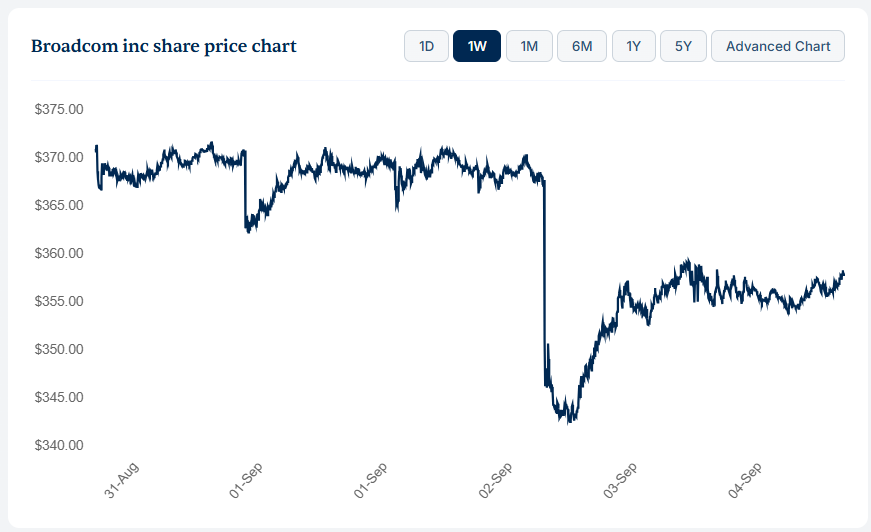
As a result, on Thursday, Broadcom’s stock fell 6.32% to $344.02, taking more than $100 billion off a company worth about $1.76 trillion.
Source: AVGO on Vested
A shortfall of $250 million in one quarter cost the company over 400X that in market value, on the same day it raised its outlook for the two years after.
Anyways, here is the part worth sitting with. Custom chips are still the smaller side of this market. TrendForce forecasts that systems built on them will make up 27.8% of AI server shipments this year, against 69.7% for systems built on general-purpose chips, and expects the custom side to grow faster.
Nvidia is probably watching the faster-growing part of its own market get built by somebody else, for its own customers.
Not everyone is relaxed about Broadcom’s side of it either. TD Cowen, which rates the stock a buy, noted after the results that “customer concentration and financing concerns remain risks.” Six customers is indeed a very short list.
America’s biggest jobs gain in months couldn’t impress WallSt.
Both of those bets, Nvidia’s $12.93 billion and Broadcom’s $230 billion, are promises about a decade that has not happened yet. On Friday morning, the price of waiting for that decade went up.
At 8:30 in New York, the US Bureau of Labor Statistics published the August jobs report. The economy added 162,000 jobs.
Economists surveyed by Bloomberg had expected 55,000. Unemployment held at 4.1%. And July looks very different now: first reported as a loss of 23,000 jobs, read then as the start of a slump, it has since been restated as a gain of 21,000.
By any normal reading, that is a good morning for a country. On Friday, the Dow closed 271 points lower, and the S&P 500 and Nasdaq fell with it.
At first instance, it feels the markets be like:

But two things explain it. The first is where the jobs actually came from. Restaurants and bars added 59,000. Local government schools added 42,000. Construction added 22,000, factories 16,000, health care 13,000. So the biggest single contributor to a strong American jobs number was restaurants hiring, followed by schools staffing up for the new year.
Kory Kantenga, LinkedIn’s head of economics for the Americas, was not convinced that it marks a turn:
“The strong gains in Leisure and Hospitality and Government are a rebound from earlier summer weakness, not a shift in trend.”
The second reason is bigger: America’s central bank is not worried about jobs right now, it is worried about prices. Inflation was running at 3.4% in July, above the Fed’s 2% target, and average hourly pay is growing at 3.1%, which means: the typical American’s wages are rising slightly slower than their cost of living.
Fed Chair Kevin Warsh had set out his position a week earlier at Jackson Hole, the yearly gathering of central bankers.
“Inflation is running above our 2 percent target. So the Fed’s predominant focus right now should be on prices.”
He also told that audience he considers the labour market to be at full employment. If the Fed thinks employment is fine, a strong jobs report reads as evidence the economy can take higher interest rates without breaking. In the futures market, the odds of a rate rise at the September 16 meeting moved to 60% from 49% the day before, according to CME FedWatch.
For anyone new to this, when interest rates rise, money kept safely in a bank earns more. That makes a company promising big profits in 2028 less attractive by comparison, so investors pay less for it today.
So now you know.
The bottom line
The biggest name in AI chips agreed this week to buy a library, two months after an open model from a Chinese lab did what its American rivals would not. The company selling custom chips to Google, Meta and OpenAI had the quarter of its life and was punished over a shortfall worth less than a day of its own revenue. And on Friday, a set of restaurant hiring numbers made every promise like theirs more expensive to hold.
That is what a market looks like when everything valuable is a promise about the 2030s. The promises do not change day to day. What changes is how much it costs to sit and wait for them, and this week that cost went up.
Nvidia was the only one acting like the waiting is worth it. It agreed to pay 86 times revenue for a company that had been hacked two months earlier.
One of those two positions will look obvious in a few years. What would have to happen for it to be the buyer?
That is a story for a future Vested Shorts. We will be here to tell you when it comes.
Thanks for reading!