




Welcome back to a new edition.
Before the stories, a quick question. This week one report about OpenAI’s revenue knocked 5.5% off Oracle and 8% off CoreWeave, two companies that build data centres and rent them out.
Why does one private company’s number move their stocks, you ask? Because their whole business is a bet that AI keeps expanding, and that expansion runs on electricity nobody has built yet. For context, check out our video: The Invisible Grid Powering The Entire AI Boom at Global Markets by Vested.
Speaking of stories…
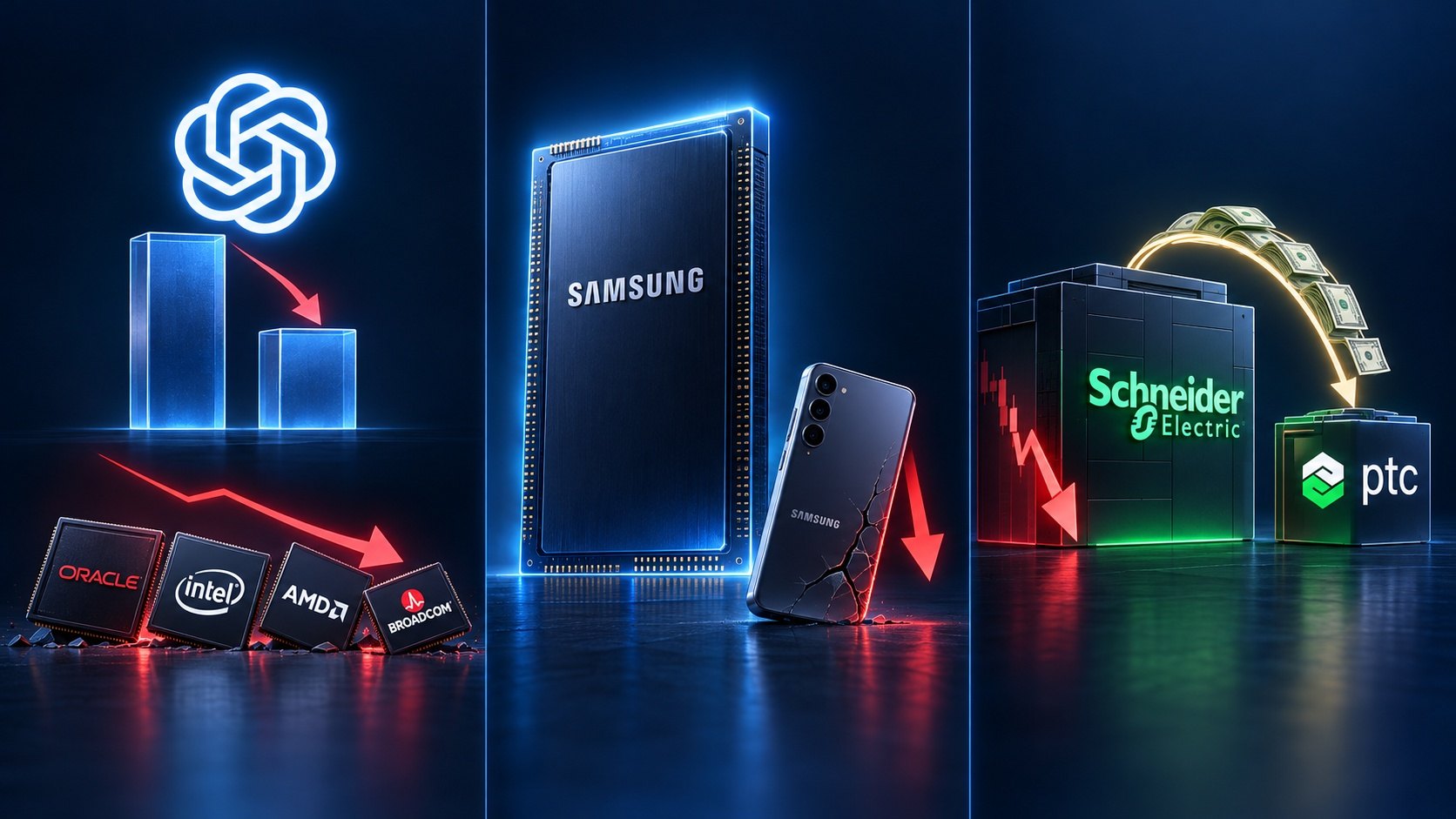
OpenAI told investors its annualised revenue was approaching $50 billion, about $20 billion below the number that circulated in August, and it had ripple effects. Oracle closed 5.5% lower.
Samsung guided to about 107.4 trillion won of quarterly operating profit, roughly $80 billion, which beats everything it earned in 2025, and its shares still fell 2.4%.
Schneider Electric agreed to pay $22.6 billion in cash for an American software company called PTC, and its own shares in Paris dropped about 10%.
We’ll get to the interesting bits. But, one exciting thing from us before the stories.
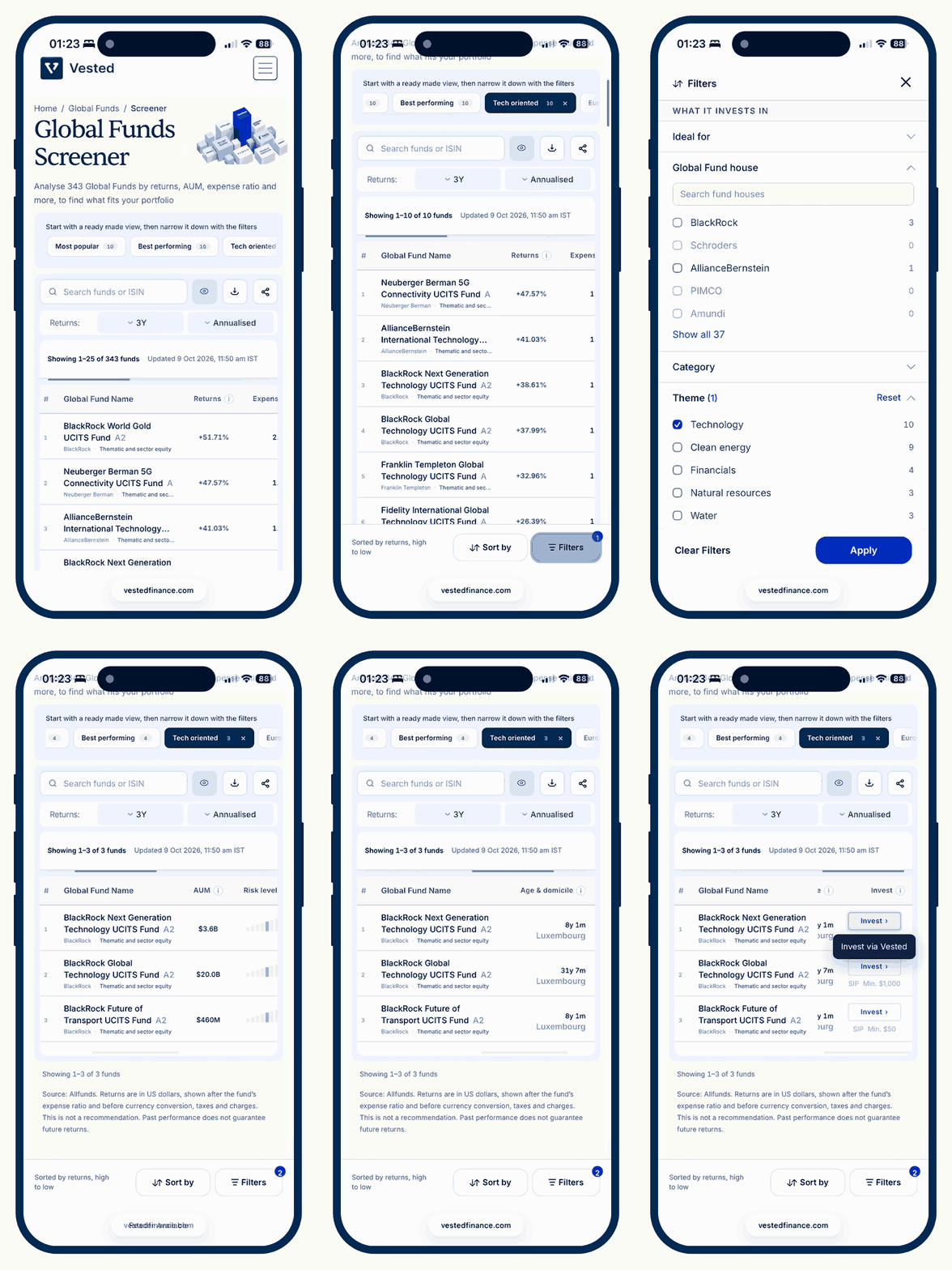
Our all-new advanced Global Funds Screener just went live on the site. You can filter every global fund on Vested by fund house, returns, AUM, expense ratio, theme and more, sort the table on any column, and invest directly or download and share your filtered list.
We have also added a bunch of other features to help you analyse and find what suits your portfolio. Check it out today, and let us know what you feel about it.
The World in a Week
Sources: AP, CNBC, Reuters, Kitco, Coinbase, Business Standard and others
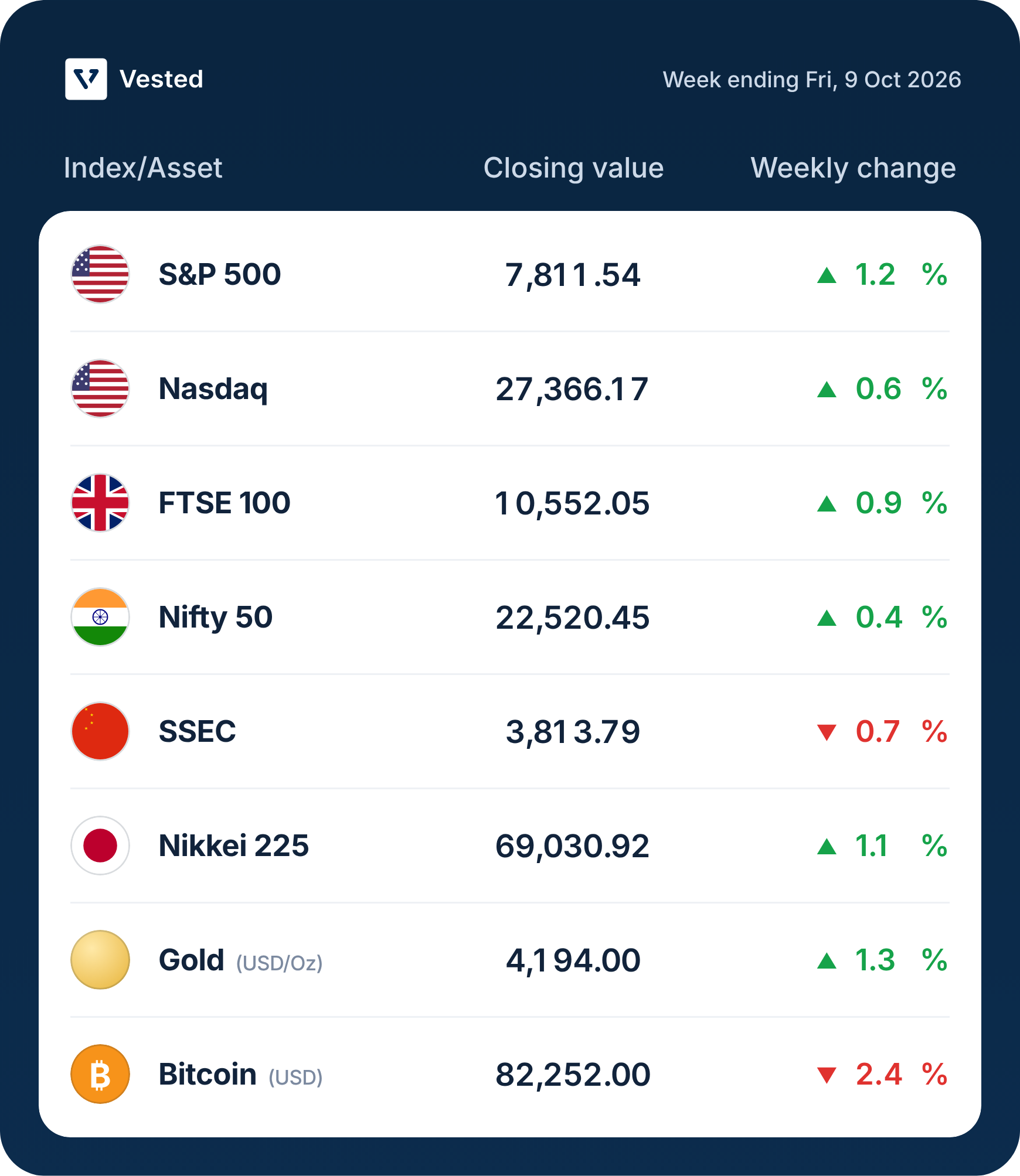
Borrowing costs set the tone. The US 10-year Treasury yield, what the US government pays to borrow, hit a 24-year high on Wednesday, then fell back to about 5.25% by Friday.
Stocks dipped midweek. A report that OpenAI’s revenue was about $20 billion below earlier estimates hit AI shares on Thursday. The S&P 500 still ended the week up 1.2% and the Nasdaq 0.6%.
Oil stayed above $100 a barrel after Hurricane Isaias shut nearly 63% of US Gulf output. It eased on Friday once Trump ruled out attacking Iran before the November 3 midterms, which lifted the FTSE 100 0.9%.
Gold bounced off a two-month low to end 1.3% higher, and Bitcoin fell 2.4%.
AI doubts hit Asian chip stocks, but the Nikkei 225 still rose 1.1%. Shanghai reopened after its holiday and the SSEC slipped 0.7%.
India caught a break. The RBI raised its key rate to 5.50%, blaming oil, inflation and a weak rupee, and foreign investors kept selling. The Nifty 50 still rose 0.4%, ending an eight-week losing run.
Rates and yields ran this week, so we thought to check how well you understand it. Test for yourself in this week’s edition of Global Investing Challenge by GlobEd.
Now, moving to the week’s stories.
News Stories
OpenAI’s revenue figure changed and WallSt. paid for it
On Thursday the Financial Times reported that OpenAI had told investors its revenue was running at about $50 billion a year as of the end of September. The figure circulating in August was close to $70 billion.
Markets read that as a $20 billion hole. The Nasdaq Composite closed 1.25% lower, its worst day since the middle of August.
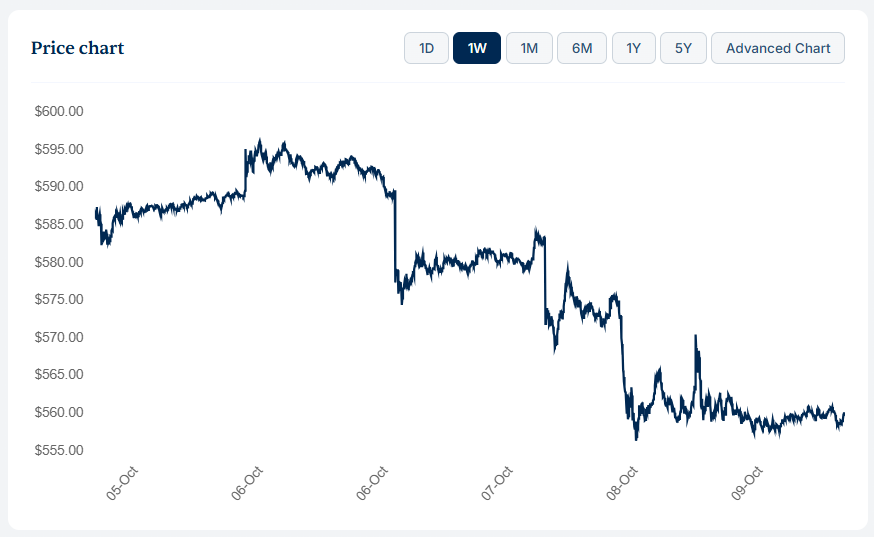
While the semiconductor ETF SOXX fell 3.4% –
Source: SOXX on Vested
Oracle lost 5.5% and CoreWeave 8%, with Intel, AMD and Broadcom all down 4% or more. OpenAI itself is private, so it has no share price to fall.
A person familiar with the matter told Reuters the two figures were simply built differently.
The August number counted gross revenue, every dollar a customer paid, including sales made through cloud partners. The newer figure counts net revenue, which is what OpenAI keeps once those partners have taken their cut. Nothing about the underlying business changed between the two numbers.
The bigger figure existed because OpenAI’s investors wanted to compare it with Anthropic, which does count partner sales and pays its cloud partners about 16% of every dollar earned through them.
Reuters’s own analysis found those partner sales made up half of Anthropic’s revenue last year. A figure built to make the two companies comparable ended up making one of them look $20 billion larger than its own accounts show.
The comparison it was assembled for had already gone against OpenAI anyway. In the second quarter OpenAI reported $6.7 billion of revenue against Anthropic’s $11.5 billion, the first time Anthropic had earned more in a quarter.
Almost none of the coverage mentioned what OpenAI said about growth in the same conversation. It put the increase in its annual revenue run rate at 77% during the third quarter, and the increase in its enterprise run rate at 107%.
For starters, a run rate is one period’s revenue multiplied out to a full year, so it describes the pace of the business today rather than money already banked.
Daniel Newman, chief executive of The Futurum Group, put OpenAI on course for a run rate of $70 billion to $90 billion by the end of the year. He wrote on X on Thursday:
“Optics here are very negative but the ramp this year has been considerable. Broader reaction is overblown in my opinion.”
Overnight the names that had been sold recovered a little, with Nvidia adding 0.5%, Oracle 0.7% and CoreWeave 0.3%.
There’s one caveat though. OpenAI is private and does not publish accounts, so the figures reaching the market arrive through investors instead of a filing. Nobody outside the room can see which definition is in use on any given day.
Samsung’s best chip quarter could be its phone’s worst
Samsung published preliminary third-quarter guidance on Thursday, which is an early estimate issued ahead of its full accounts. It expects revenue of about 195 trillion won and operating profit of about 107.4 trillion won, which works out at roughly $80 billion.
Operating profit a year earlier was about 12.2 trillion won, so the figure is up 782.5%. Revenue rose 126.6%. This is the first quarter in Samsung’s history above 100 trillion won of operating profit.
Here is the number that is worth sitting with for a moment. Samsung’s operating profit for the whole of 2025 was 43.6 trillion won. One quarter of 2026 has now earned it about 2.5 times its entire previous year.
The won strengthened about 14.3% during the quarter, which shrinks the profit once it is converted back into Korean currency.
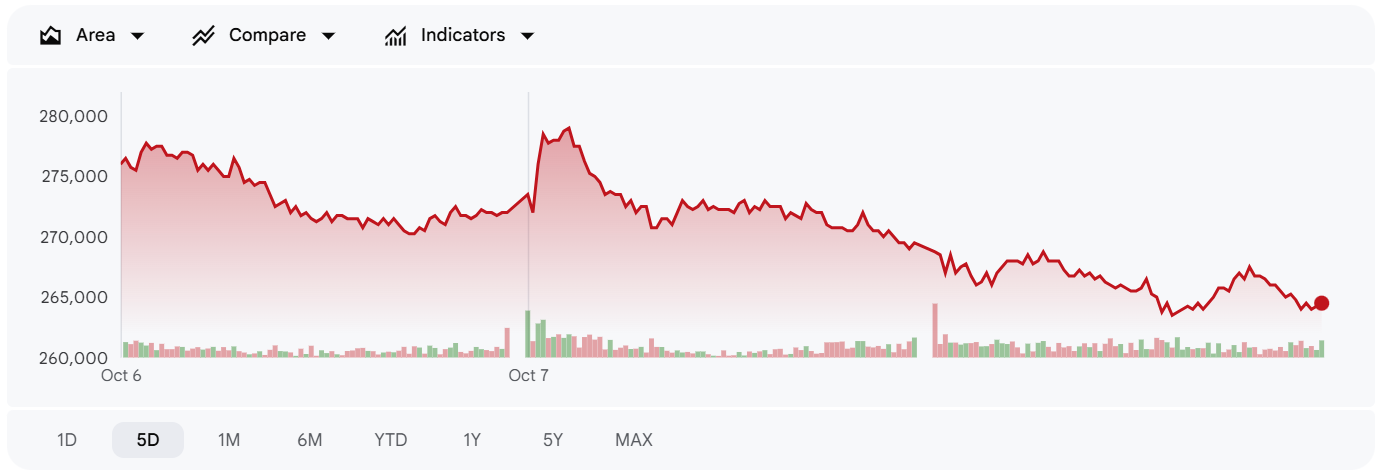
The shares still fell 2.4% on the day. The beat vs estimates was small, and they had already drifted down about 6% from 285,500 won on 23 September before the announcement arrived.
Source: Google Finance
High-bandwidth memory (HBM) is doing much of the work. Samsung’s HBM shipments, measured by memory volume, rose nearly 50% from the previous quarter, according to Reuters, helped by demand tied to Nvidia’s Vera Rubin accelerators.
The part that got less attention sits inside Samsung itself. The division that makes phones and appliances posted its first quarterly operating loss on record in the second quarter, 800 billion won.
Seoul Economic Daily cites analysts estimating that the third-quarter loss widened past 1 trillion won. Samsung does not publish a full breakdown by division until 29 October, so those are estimates as of now.
So the company selling memory at record margins is also the company paying record prices for it. One quarter earned Samsung more than all of last year, and its own phone division still lost money.
On Friday, Nikkei Asia reported that Apple has told some suppliers to cut October component orders for the iPhone 18 Pro and Pro Max by 15% to 20%.
Nikkei cites weaker demand than expected after prices rose, and says the smaller orders may partly reflect Apple’s changed launch schedule.
Memory used to account for 10% to 15% of what it costs to build a smartphone, according to TrendForce. It now accounts for 30% to 40%.
For a mainstream handset with 8GB of memory and 256GB of storage, first-quarter bulk contract prices were up nearly 200% on a year earlier. TrendForce expects global smartphone production to fall about 10% in 2026, to roughly 1.135 billion units.
Samsung and Micron both expect memory supply to stay tight through 2028, and prices for ordinary memory chips could reportedly rise a further 10% to 15% this quarter.
Schneider’s largest acquisition ever hit its own stock
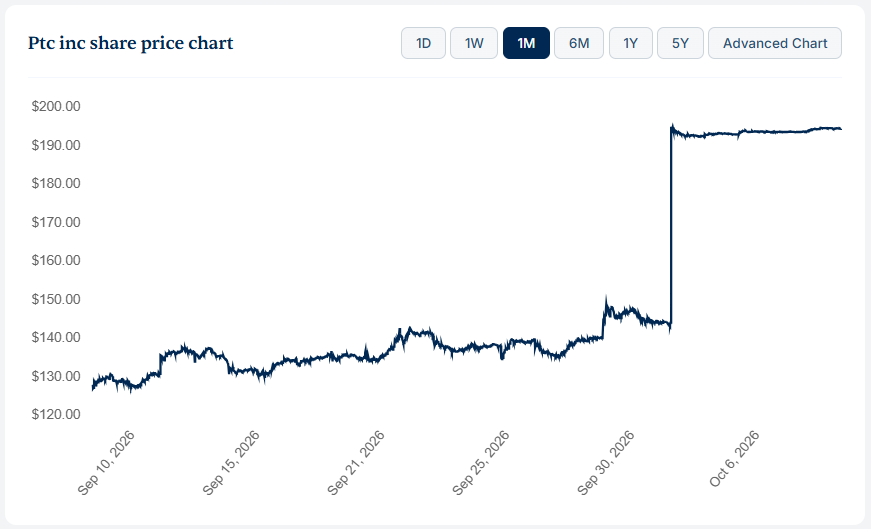
On Monday, the French electrical equipment maker Schneider Electric agreed to buy PTC for $205 a share in cash. That values PTC’s equity at about $22.6 billion, or $23.7 billion counting its net debt.
PTC closed at $144.03 the previous Friday, so the offer carries a premium of 42.3%.
PTC shareholders took the news well and sent the stock up 33.7% on Monday.
Source: PTC on Vested
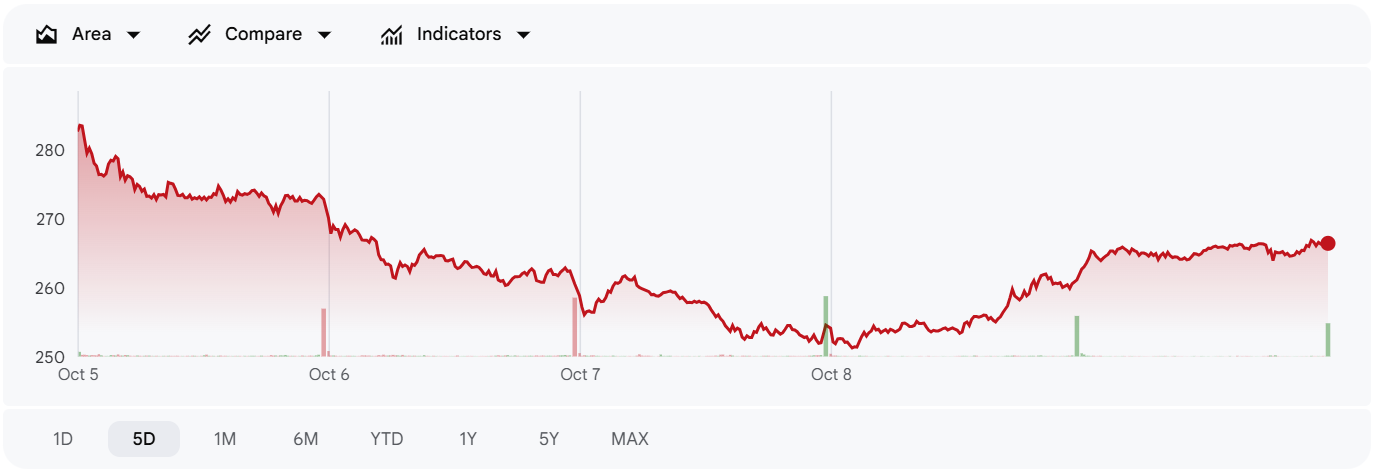
Whereas Schneider’s own shareholders took it differently, and the shares in Paris closed about 10% lower.
Source: Google Finance
For context, PTC is a Boston company whose software helps engineers design physical products. Revenue was €2.4 billion in calendar 2025 at an adjusted operating margin of about 40%, with more than 30,000 customers.
What makes the price defensible is the spare cash PTC throws off, the money left after running the business and paying for equipment. Free cash flow was $857 million in the year to September 2025, against $344 million four years earlier.
This is the largest acquisition Schneider has ever made, ahead of the roughly $11 billion it paid for Aveva in 2023. It is also its third deal above $1 billion this year, in a year Axios notes has been thin on large software mergers.
Schneider is paying 21 times its own estimate of PTC’s 2027 adjusted operating profit. Counting every saving and extra sale it expects, that falls to 13 times.
A multiple is simply the price divided by annual profit, so 21 times means the purchase price equals 21 years of profit at today’s level.
Olivier Blum, Schneider’s chief executive, put it that way when he explained the purchase –
“[…] we bring the last brick in our portfolio, which is product and engineering intelligence”
Then there is the question of how Schneider pays for it. The company needs about €22 billion of cash, covered for now by a short-term loan it has already lined up, a committed bridge loan from Morgan Stanley and Société Générale.
It plans to replace that bridge with €5 billion to €6 billion of new shares and €16 billion to €17 billion of new debt.
The savings being promised are €250 million a year by the third year, plus about €800 million of additional revenue. Both of those arrive years after the €22 billion leaves.
Worth saying plainly: none of this is done. Closing is expected by the third quarter of 2027, a majority of PTC shareholders have to approve it, and so do regulators.
A cash takeover ends with money arriving in the accounts of everyone who held the shares. That makes it a reasonable moment to check your own account details are current.
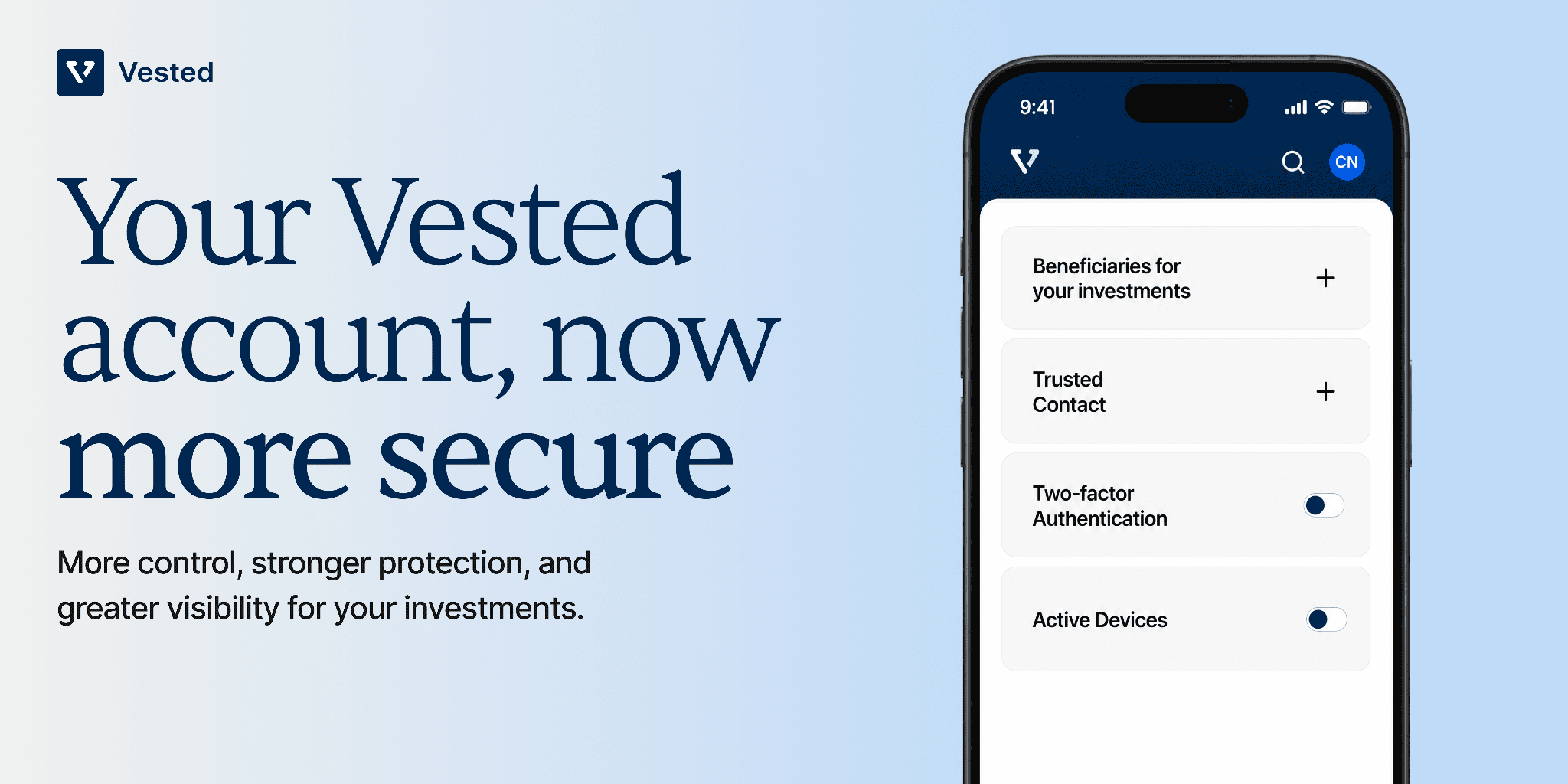
Because when your portfolio grows, protecting your investments and account becomes just as important as building them. We’ve introduced four new security updates to give you more control, visibility, and protection.
Click the banner below to explore them.
The bottom line
Who actually pays for a boom?
Not the company at the centre of it, usually. The costs travel outward along the chain of suppliers and buyers, and they keep moving until they reach somebody with nobody left to charge.
Often that is the person at the end of the chain, holding a handset and wondering why the price went up this year.
What is unusual about this boom is the length of that chain. Demand for machines inside a data centre now helps set the price of a phone sold here in India.
So the question worth carrying into next week is where the chain stops, and who is standing there.
That is a story for a future Vested Shorts. We will be here to tell you when it comes.
Thanks for reading!