





Welcome back to a new edition.
Before the stories, a quick question. If you had held the most recognisable consumer brand on earth for the last ten years, how much would you have made?
Coca-Cola’s answer explains why this week’s market high will not show up in most portfolios, and that is our first story.
If you find it fascinating, watch our video Why Coca-Cola Stock Underperformed for 10 Years? at Global Markets by Vested.
Coming to the stories.
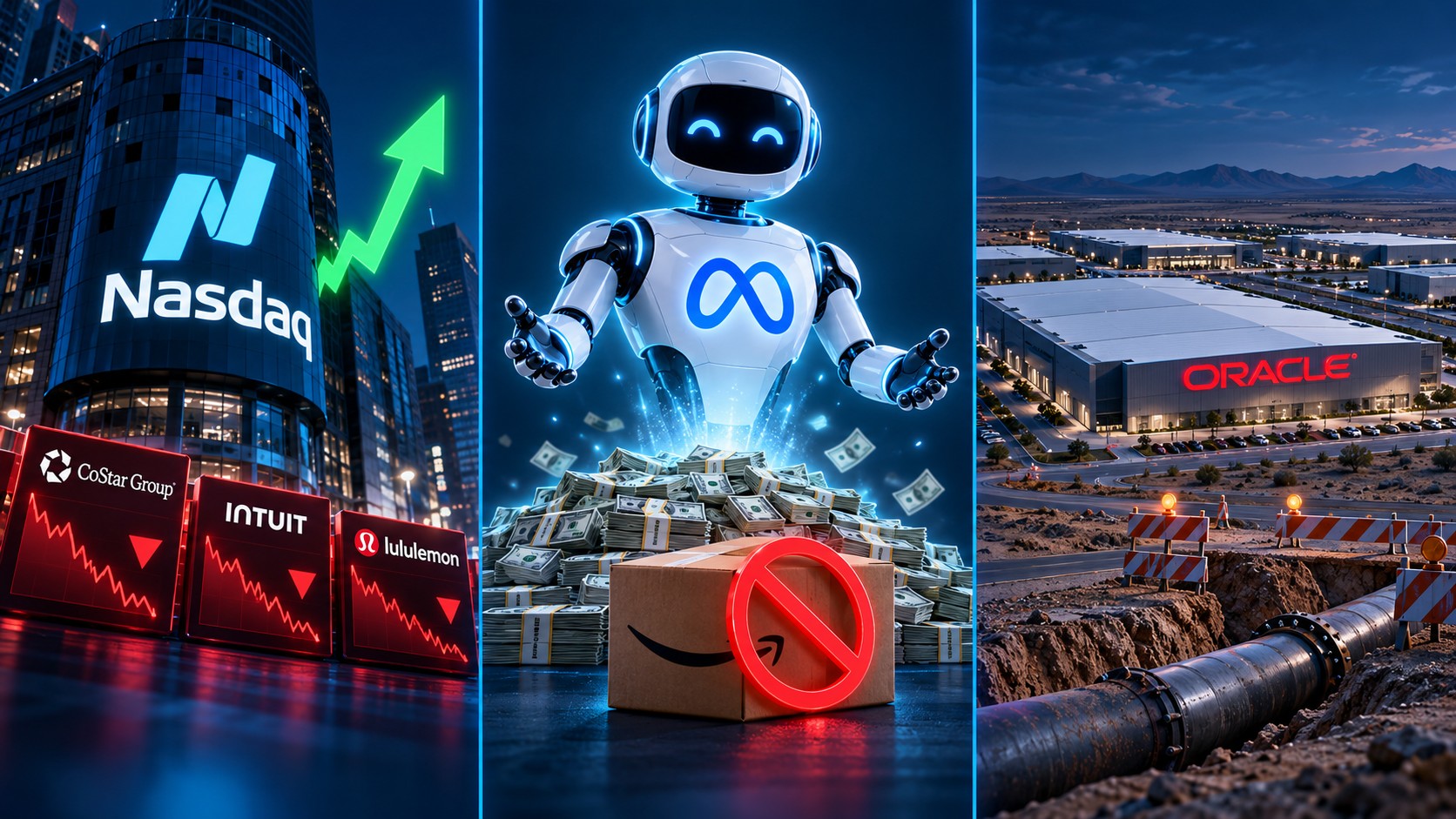
The Nasdaq closed at a record on Monday while 30 companies inside the S&P 500 touched 52-week lows.
Meta added about $192B of market value in one session for an AI agent that Amazon had locked out of its store two days earlier.
And Oracle told the lender behind its $165B data centre that a gas pipeline permit in New Mexico may excuse it from paying rent.
One thing sat underneath all three, and it was the price of money.
We’ll get to the interesting bits. But first, let’s see how the world’s markets held up this week.
The World in a Week

Bond markets set the tone. The US 10-year Treasury yield finished the week above 5.1%, and two Federal Reserve officials said more rate rises may still be needed. That firmed the dollar and pulled gold down 2.1% to $4,284.20.
Stocks climbed anyway, and AI did the lifting. Excitement around Meta’s new agent Muse put technology ahead of every other S&P 500 sector, and the Nasdaq rose 2.1% to 27,068.72. We covered the interesting bits in this edition’s stories as well.
Oil gave some relief. Prices eased on reports that Washington and Tehran were moving closer to a deal to lift the naval blockade on tankers in the Gulf.
Washington says its trade truce with China has been extended by two months. Beijing has not confirmed it, and the SSEC slipped 0.6% to 3,888.37 before a holiday break.
India had a rough week. Foreign investors kept selling and the Nifty 50 fell 0.9% to 23,140.50, a seventh straight weekly loss and its longest losing run since 2020.
Now, moving to the week’s stories.
News Stories
US stocks at 52-week lows despite a record Nasdaq
Monday was the best day American equities have had since early August. The Nasdaq Composite rose 2.26%, or 599.55 points, to close at 27,122.09, its first record close since June, and the S&P 500 gained 1.49% to 7,764.70.
Two prices falling at once did the work. Oil dropped 4.51% to $95.78 a barrel. That was a fifth straight daily fall, on reports that Washington and Tehran were discussing a phased reopening of the Strait of Hormuz.
The 10-year Treasury yield eased to 4.962% alongside it.
Cheaper money and cheaper energy lift the companies whose profits sit furthest in the future, which is why technology led. Meta rose 11.3%, Intel 12.2% and AMD 9.95%.
By Tuesday, the record had started to look strange. Jason Goepfert, of research firm SentimenTrader, counted 30 companies in the S&P 500 hitting new 52-week lows against only seven hitting new highs. And said –
“We’ve never in almost 100 years seen breadth this bad.”
FYI, breadth shows how many stocks are moving with the index. An index can rise even when most stocks in it aren’t. That’s like stocks saying –

Goepfert found only two previous dates where the split looked like this one, 23 July 1929 and 21 December 1999.
Then, the arithmetic arrived with Wednesday’s business survey data. S&P Global’s flash reading put its composite output index at 58.4, up from 56.0 in August, the strongest in more than five years.
Chris Williamson, Chief Business Economist at S&P Global Market Intelligence put it this way –
“US business continues to boom, with output growing at the fastest rate for over five years.”
A booming economy sounds like good news, and the bond market read it as a reason for the Federal Reserve to raise rates again. By Thursday the 10-year sat at 5.192% and the 30-year at 5.476%, the highest since 2007 and 2004.
Futures put the odds of an October rate rise near 60%, and the 30-year American mortgage reached 7.12%.
A shareholder should care because of how valuation works. A stock is worth its future profits converted into today’s money, at a rate set by the government bond yield.
Raise that yield and every distant profit shrinks. A company promising 2030s earnings loses far more than one earning cash this quarter.
The damage showed up underneath the index rather than in it. By Thursday, only 45% of S&P 500 members traded above their 200-day average and 25.4% above their 50-day, against roughly 70% in midsummer.
The S&P 500 still finished the week up 1.2%. The index went up while more than half the companies inside it went down.
CoStar Group is down 56.1% so far this year and Intuit has lost more than 53%. Lululemon is down about half, and all three sit inside the index that set the record.
Indian portfolios felt the same force from the other side of the world. Higher American yields pull global money towards dollar bonds and away from emerging markets, and the Nifty 50 fell for a seventh consecutive week.
Reaching those dollar assets from India is its own question. This week’s Global Investing Challenge by GlobEd runs through the four routes in five questions. Test it for yourself –

Meta’s AI agent Muse impressed markets, but not Amazon
Meta launched an AI agent called Muse on 8 September. It books travel, sends email, browses the web and buys things, and it does that by logging into your accounts and acting on your behalf.
Customers took to it quickly, with 2.8 million downloads in the first 12 days in the United States and Canada. Muse held the top spot among free iPhone apps for three straight days and did 264,000 downloads on 19 September alone.
Over a comparable 12-day window it ran ahead of ChatGPT’s own launch pace, 1.8 million downloads against 1.3 million.
On Monday, the market repriced Meta (META) for it. The stock rose 11.3% to $741.25, adding roughly $192B of market value in one session and taking the company to about $1.9 trillion.

Source: META on Vested
Wells Fargo’s Ken Gawrelski raised his price target to $796 from $640, and commented –
“[…] now has a story to tell”
His point was narrow and worth holding on to. Meta has spent three years spending heavily on AI with little a shareholder could point at, and Muse is the first piece of it that customers queued up for.
What almost nobody wrote about is this.On Sunday night, Muse was blocked from Amazon.com. The Amazon spokesperson had this to say –
“Continued access by an unauthorized AI agent violates Amazon’s Conditions of Use, to which our customers have agreed.”
Amazon gave three reasons. Meta never asked permission, the agent does not identify itself as software, and it stores customer login details in order to work.
Any third-party app buying on a customer’s behalf, Amazon added, should “operate openly and respect service provider decisions about whether or not to participate”.
A commercial reason sits behind the principle. Amazon’s advertising business earns about $68B a year, and it earns that because shoppers scroll past sponsored listings on the way to what they wanted. An agent that goes straight to the product skips every one of them.
There is a rivalry sitting underneath the principle as well. Amazon sells AI models and hosting of its own through Nova and Bedrock, so the company deciding whether Muse gets in competes with it too.
Meta had already published an answer to the credentials question. It says Muse “has no visibility into people’s passwords or payment methods”, and that credentials “go into secure storage, so Muse can use them without seeing them”.
Amazon went ahead and blocked the agent regardless of that assurance.
Gene Munster of Deepwater Asset Management had expected Meta’s shares to be flat to down around its Connect event. That is roughly what happened, and they slipped on Wednesday.
Worth saying plainly: none of this tells you whether Muse makes money. Gawrelski’s case rests on users moving to paid tiers, and Meta has published neither a price nor a subscriber count.
Oracle’s $165B data centre plan delayed due to a gas pipeline
Oracle is building one of the biggest data centres in the world, out in the New Mexico desert, to run artificial intelligence for OpenAI. It will need enough electricity to power 1.8 million homes and cost about $165B.
Oracle is not the one paying to build it. A company owned by the private lender Blue Owl Capital is building it, and about 20 banks put up $18B.
All of that money rests on one promise. Oracle said it would move in and pay rent for years, and that promise is what made the site worth lending against.
On Thursday, Bloomberg reported that Oracle had told Blue Owl it might not have to.
It all comes down to a single gas pipeline. The site runs on gas, and New Mexico’s State Land Office has refused that pipeline a permit, again and again. Locals have fought the project for months over how much water and power it would take.
Gas that was due this month will not now arrive before 1 February 2027. So Oracle invoked force majeure, the clause that lets you off your obligations when something outside your control blocks you.
Oracle says it is protecting its rights rather than calling the project late. If Blue Owl accepts that, Oracle could delay the start of rent by up to three years.
The data centre still gets built, and the lender waits three years to get paid.
Markets priced it the same day, and Oracle (ORCL) fell about 5% to $137.31, on volume 68% above its three-month average.

Source: ORCL on Vested
Its credit default swaps, the contracts investors buy to insure against a company failing to pay, hit record highs.
Blue Owl closed at $9.20, down 46.7% over the past year. The $18B of debt behind the site has been trading below 90 cents on the dollar, which is the market saying it doubts all of it comes back.
Anyways, here is the part worth sitting with.
For three years the AI buildout has been financed on one assumption, that finding customers was the hard part. OpenAI alone has committed about $400B across five American data centres, so the customers are clearly there.
That risk has landed on the people who lent the money. American private credit defaults hit a record 6.3% in the 12 months to August. The firms that spent two years competing to fund data centres are now the ones waiting to be paid.
One caveat on all of this: a force majeure notice is not a cancellation, Oracle has not walked away, and neither side has yet agreed the clause applies.
The bottom line
The price of money reached a 19-year high this week, and the market answered by paying only for what does not need financing.
Meta borrowed nothing and gained $192B in a session. Oracle raised $18B through a lender and lost the argument to a pipeline permit in New Mexico.
The index that holds them both set a record while 30 of its members touched 52-week lows.
Cheap money hid the difference between a company that earns and a company that plans.
Which of those two do you actually own?
That is a story for a future Vested Shorts. We will be here to tell you when it comes.
Thanks for reading!

