





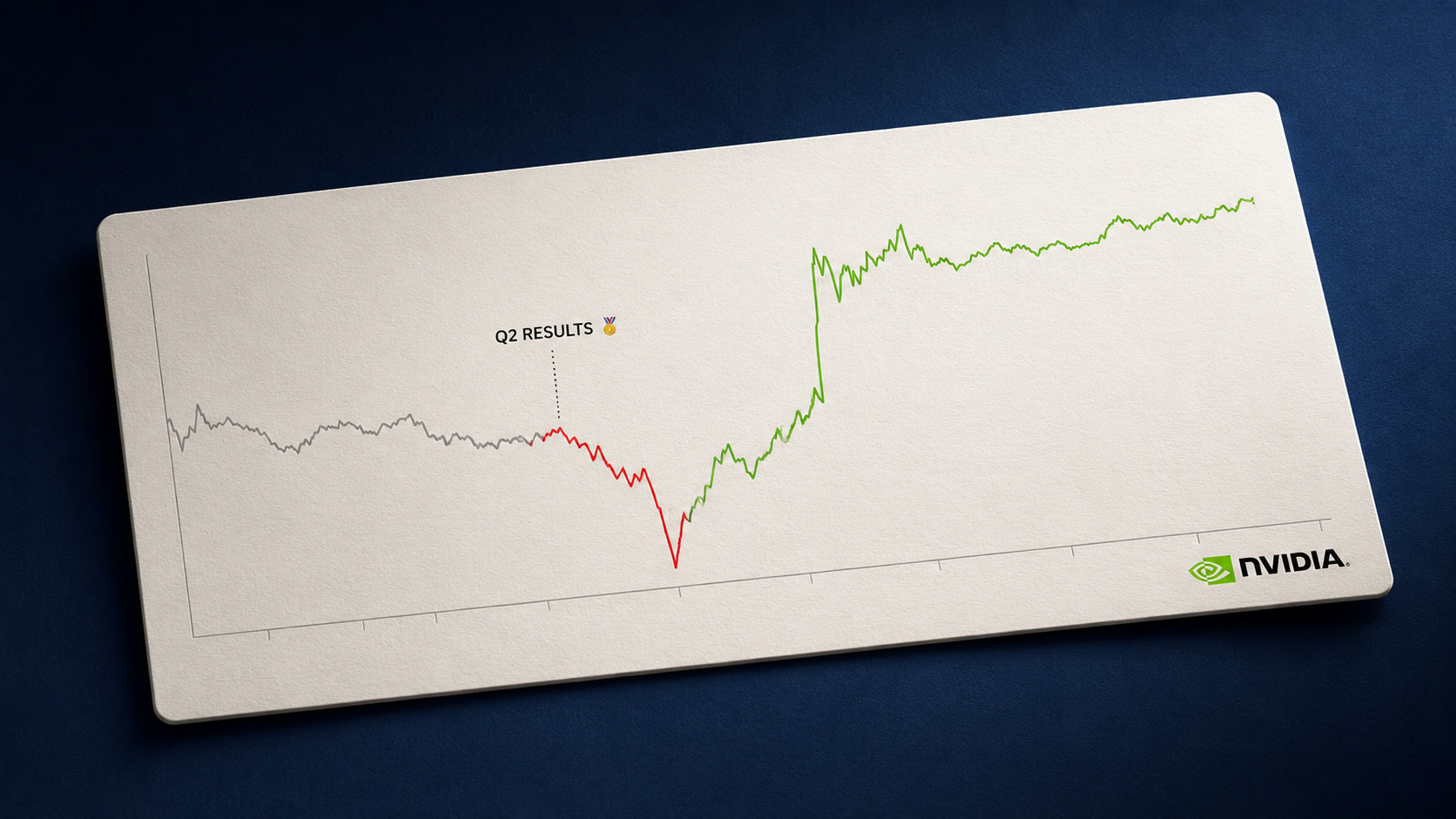
Nvidia reported its second-quarter results for the year 2027 after the market close yesterday.
If you ask me, the results were really, really strong.
Revenue was $96.2 billion, up 106% from a year ago. Data centre revenue was up 117% from a year ago, with revenue of $89 billion.
Practically, both exceeded expectations.
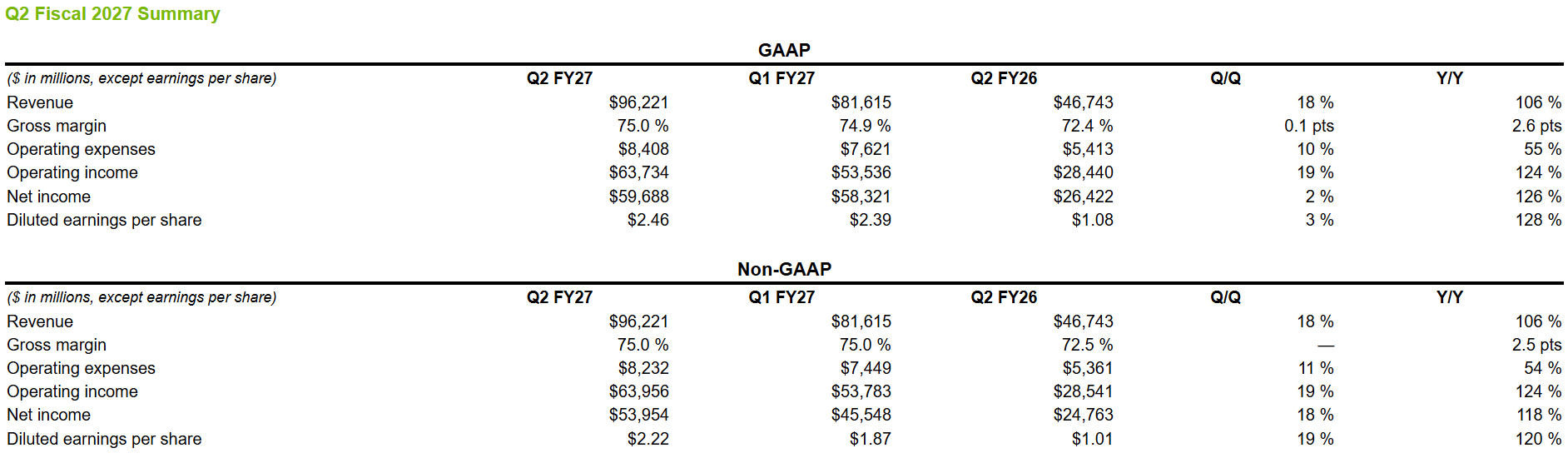
Source: Nvidia Quarterly Report, Q2 2027
The table also shows why the margin conversation started here. Gross margin came in at 75%, flat against the 74.9% Nvidia reported in the April quarter.
For the next quarter, the company guided to $108 billion in revenue and management also mentioned that revenue for 2028 is likely to grow by 70%.
And of course, the stock reacted to the results. The stock rose 4% after market hours.
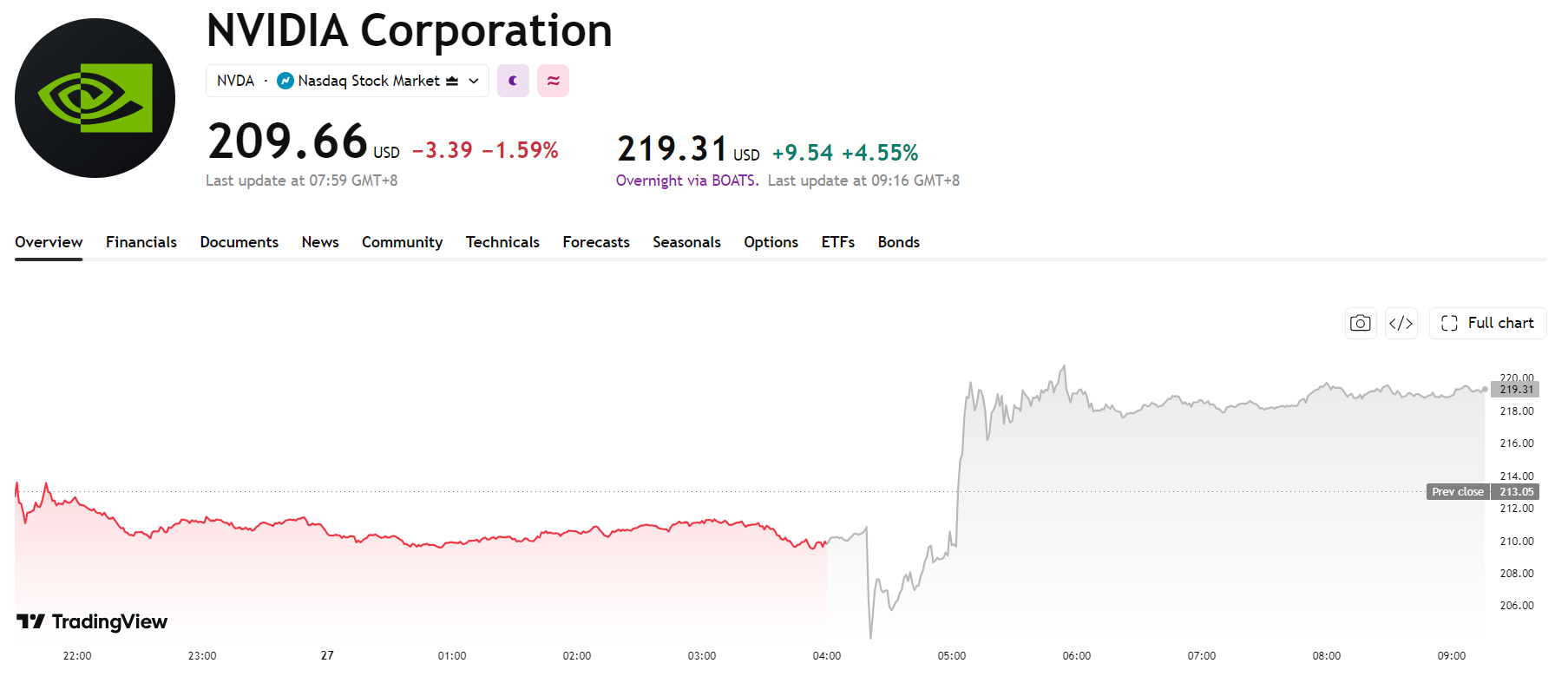
Source: TradingView
That is quite interesting because Nvidia shares have fallen the day after each of the last four earnings reports, despite the company beating expectations every single time.
I think the stock reacted not so much to the earnings, but to three other things:
- Nvidia told investors that its profit margin will fall over the next two quarters
- On the balance sheet, supply commitments more than doubled in three months. We wrote earlier about how Nvidia’s balance sheet is becoming a product in itself (here), and this quarter takes that story further.
- The CEO confirmed Nvidia will raise its prices early next year
Now, these three are connected, and together they tell a slightly different story of the quarter. Nvidia’s biggest input cost is going up fast. It is going up because of Nvidia’s own customers. And Nvidia is about to find out whether it can make those customers pay for it. Will the cost pass through? That is what this blog is all about.
Making sense of guidance
First, the margins.
In this quarter, margins were fine. Nvidia reported a gross margin of 75%, which was in line with the previous quarter.
The problem, sort of, is that for the current quarter (Q3), the company expects margins to be around 74%. The CFO (Colette Kress) mentioned that the margin will fall to 71% or 72% by the January quarter and recover to 72% to 73% next year once the price increase kicks in.
The obvious question then is why the fall. The obvious answer is memory.
Kress put it on the call: “memory scarcity today is being driven in large part by the AI buildout itself.”
Let me simplify this, because this is the context essentially.
Every AI chip Nvidia sells comes with a special kind of fast memory called high-bandwidth memory, or HBM. Every data center that Nvidia’s customers build soaks up more of the world’s memory supply. But the world cannot make memory any faster than it can build memory factories, and supply is already squeezed at Samsung, SK Hynix and Micron, the three companies that make this memory. A factory takes years to build. Ordering more GPUs is just placing an order. So the faster Nvidia grows, the scarcer memory gets, and basic economics takes over: demand goes up, supply stays steady, so the price goes up.
Nvidia has admitted that memory prices rose more than it expected. A company that plans its supply years in advance was essentially caught off guard.
Now look at what Nvidia did about it.
Last quarter, Nvidia had promised to buy $119 billion worth of supplies from its vendors. This quarter, that number is $279 billion. The company said the jump was mostly about locking up memory. Think about that for a second. That is $160 billion of new buying commitments in three months, almost three times the revenue Nvidia reported. Inventory is also up to $32 billion, as the company stocks up for its new Vera Rubin chips.
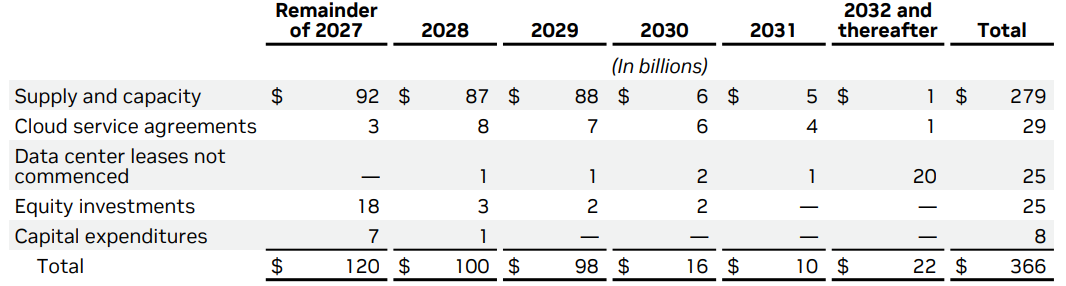
Source: Nvidia CFO Commentary, Q2 2027
Look at the timing rather than the total. Of the $279 billion, roughly $267 billion falls due by the end of fiscal 2029. It is concentrated in the next three years, which is exactly the window in which anyone worried about an AI slowdown is worried.
Now you can understand this in two ways and I think both are true at once.
- This is very smart. Nvidia says demand is much higher than the 70% growth it can supply, and Kress mentioned its chips are fully used across every cloud it serves. When you have more customers than you can serve, getting hold of every scarce part makes a lot of sense, because whatever you can build, you can potentially sell it. It also means the competition is standing behind and gets less of it. That, in itself, creates a moat.
- This is a very large bet turned into binding contracts. Memory is essentially a commodity and is impacted most by the boom-and-bust cycle. Its entire history is one loop repeating: shortage, then overbuilding, then a crash. Nvidia has just become the biggest forward buyer that loop has ever seen. If AI demand in late 2027 turns out even a little softer than planned, then Nvidia technically will be sitting on the most expensive pile of memory ever purchased, at the top of the cycle. So possibly, margins of 75% have never carried that kind of risk before. That is my assessment.
The price increase and the potential result
Now, the last part is, of course, the price rise. For me, this was the most interesting disclosure of the entire call.
Huang confirmed that the price increase takes effect early next year. And notice one thing: the margin recovery that Kress promised, back to 72% or 73%, depends on this increase going through.
So effectively Nvidia is not planning to absorb the higher memory costs. It is rather planning to pass the price rise to its customers.
The obvious question is: can it? The company’s argument is that customers can easily afford it.
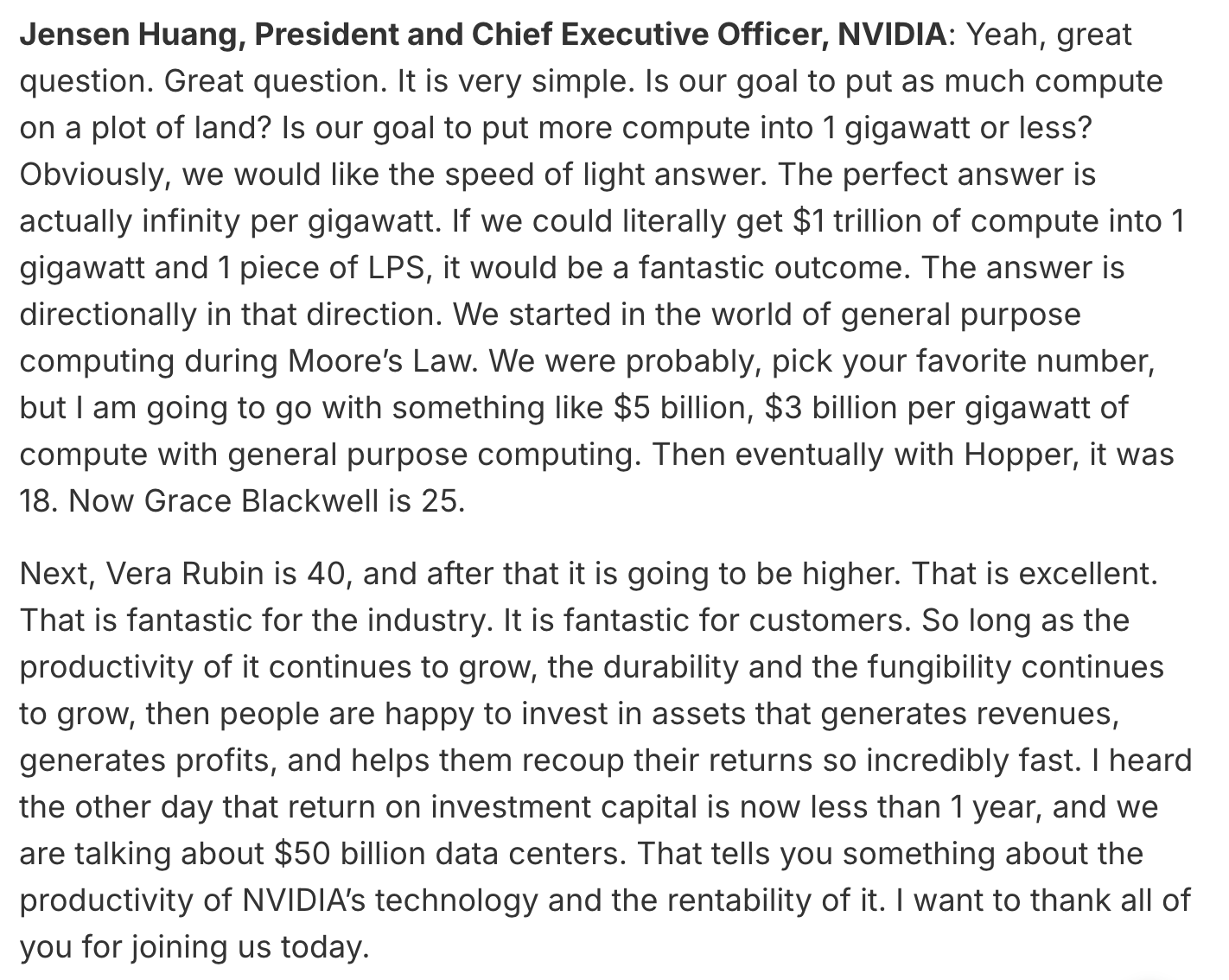
Huang shared a striking set of numbers on the call. For every gigawatt of data center capacity a customer builds, Nvidia’s share of the spending was about $18 billion in the Hopper generation of chips, then $25 billion with Blackwell and now about $40 billion with the new Vera Rubin chips. He also mentioned that the customers now earn back their AI investments in under a year. If that is true, the customers will surely pay the price rise set by Nvidia without blinking.
Source: Investing.com
But let me tell you why I find this so useful. A price increase is the cleanest possible test of pricing power.
For the last three years, the entire debate about Nvidia has been sort of theoretical. Does its software advantage hold? Do the custom chips its customers are building actually matter? But there was possibly no clear answer. Now we will likely get a clear one, possibly once the price rise is in force.
One caution is that the pressure will not fall on everyone equally, and you can see this in two groups of customers:
- The biggest buyers have alternatives. Google build its own TPU chips. Amazon has Trainium. OpenAI just unveiled its own chips – Jalapeno. So these customers can surely negotiate.
- The small companies and ordinary enterprises have no alternatives at all. They are the captive customers and have to bear this price rise.
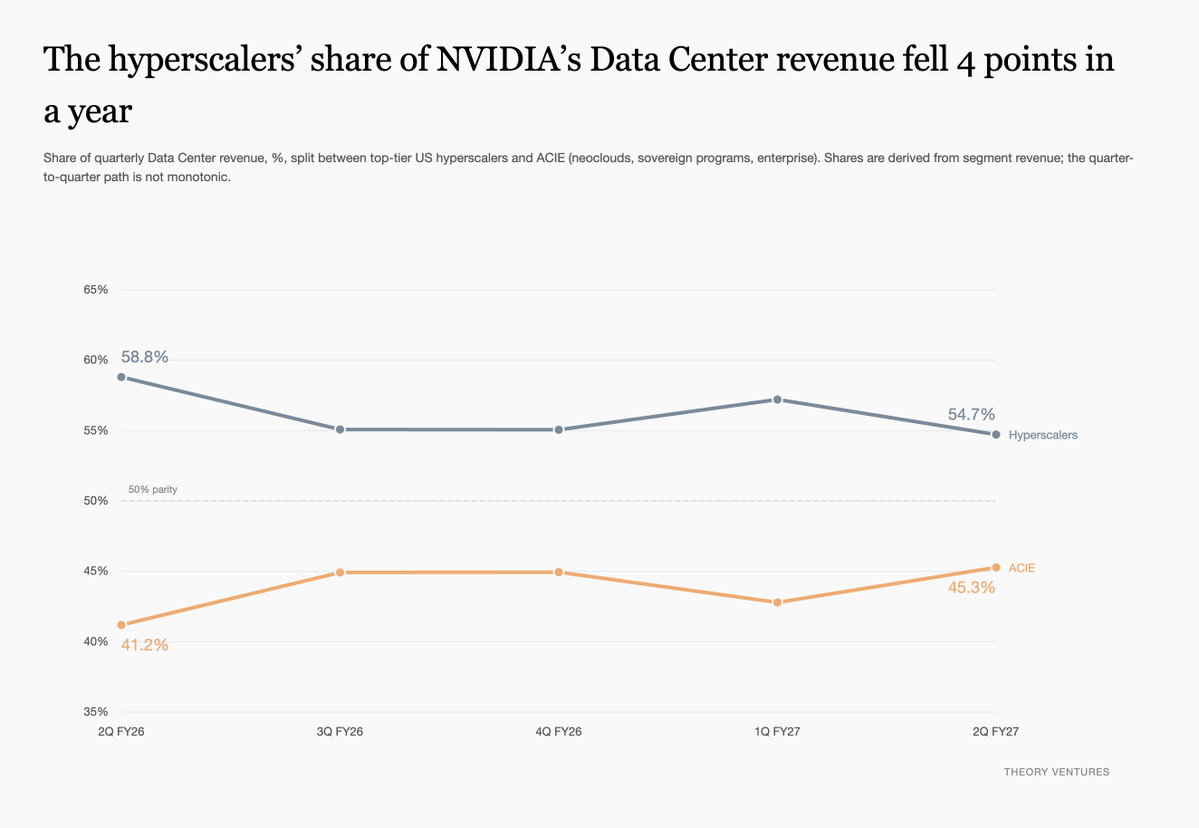
The group with alternatives (hyperscalers) is slowly becoming a smaller part of Nvidia’s data centre revenue. The group without alternatives, meaning neoclouds, sovereign programmes and ordinary enterprises, is becoming a larger one. Both moves point the same way. The buyers least able to push back are the buyers gaining share.
Source: Theory Ventures
Finally, the margins will tell a final story of whether the price rise has worked or not. It will not tell us who actually paid.
The margin threat
Coming into this quarter, everyone was worried about competition eating Nvidia’s margins: AMD, custom chips, rival software.
That worry is still valid. But the margin pressure that actually popped up was from the other side – suppliers charging more, essentially.
So, here is the basic rule of any supply chain: the big profits flow to whoever owns the scarce part that nobody can substitute. For three years, that was Nvidia. Today, it is the memory makers: SK Hynix, Samsung and Micron.
So here is where we are.
The $279 billion in commitments is Nvidia buying its way back to the front of the memory line. The price increase is Nvidia asking its customers to pay for the ticket. Both moves work only as long as demand for AI computing stays ahead of supply. How long will that last? Honestly, nobody knows. Nvidia just bet $279 billion that it lasts a long time.