Welcome back to a new edition.
Before the stories, a question about this week. Every company in this edition is either losing money, promising money it does not have, or unable to build what it has sold.
So who in the AI build-out is actually getting paid right now?
Our video looks at an answer that rarely comes up: the cooling and power equipment every AI data centre has to buy before a single chip runs.
Watch it here: Why Vertiv Is Quietly Outperforming The Entire Market at Global Markets by Vested.
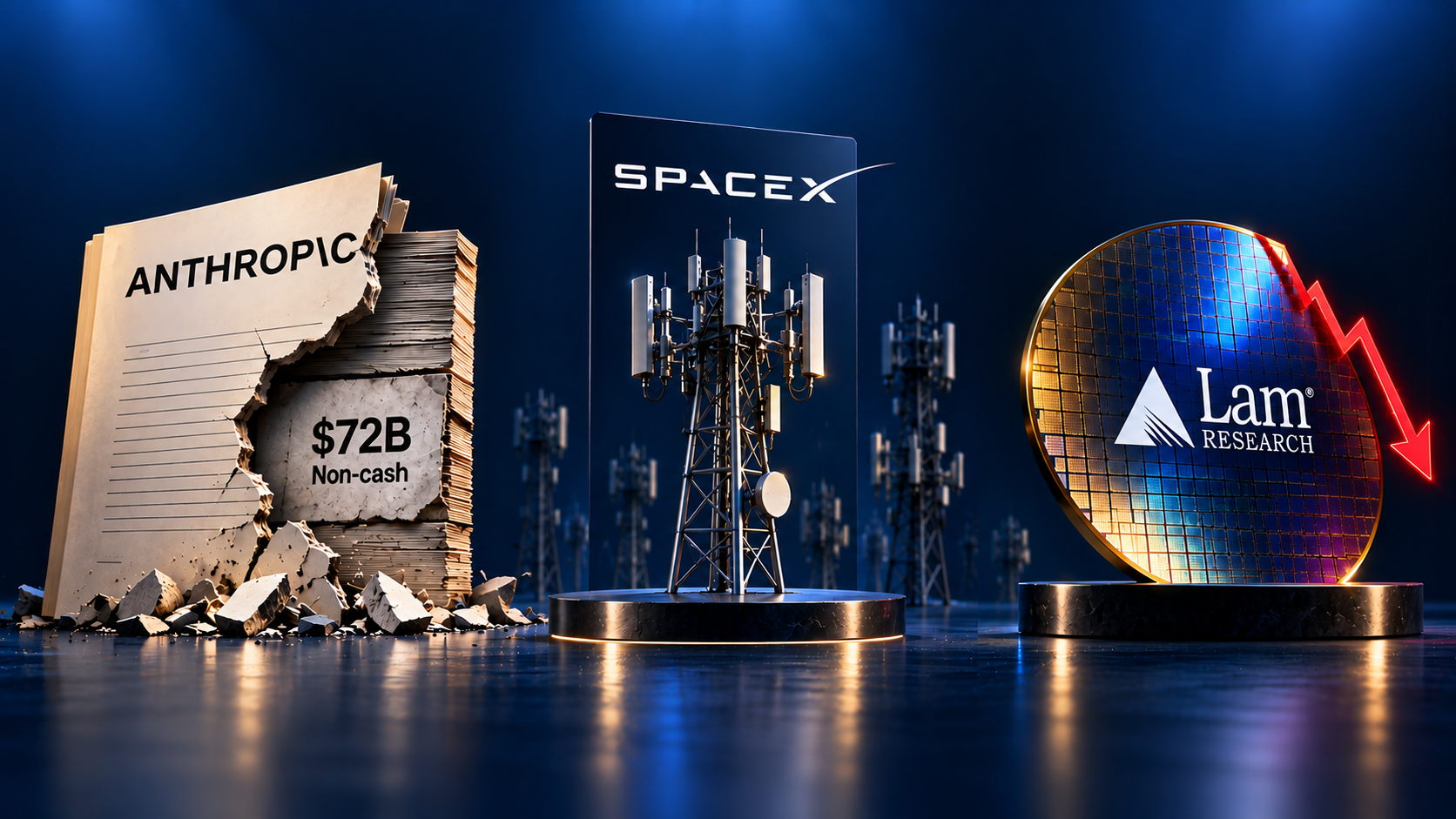
Anthropic’s draft IPO prospectus showed $16.3 billion of revenue for six months and an $80.7 billion loss. But about 90% of that loss wasn’t in cash.
SpaceX is reportedly in talks for 80,000 American cell sites and has not signed a lease. AT&T, Verizon and T-Mobile fell anyway, while the tower owners rose.
Lam Research posted the best quarter in its 46-year history, crossed a 40% operating margin for the first time, and the stock fell about 12%.
We’ll get to the interesting bits. But one thing from us before the stories. If you wish to test how much you know about how an earnings report moves a share price, this week’s Global Investing Challenge by GlobEd is for you.
Now, let’s see how the world’s markets held up this week.
The World in a Week

Oil set the tone again. Brent crude rose to about $116.72 a barrel, another weekly gain, after Houthi attacks in Saudi Arabia and fresh US-Iran tension near the Strait of Hormuz. Costlier oil feeds inflation, so traders now put the odds of a Fed rate rise by December above 80%.
Gold pays no interest, so higher rates hurt it most. It fell 4.0% and briefly slipped below $4,000 for the first time since mid-July.
Tech had its own problem. Meta fell about 7% after its results and Tesla cut its spending plan, leaving investors doubting how long the AI boom lasts. The Nasdaq fell 0.7% to 25,955.34 and the S&P 500 0.5% to 7,623.68. Only the Dow rose, up 0.4%.
The selloff spread to Asia. Japan’s Nikkei 225 dropped 4.0%, while China’s SSEC fell just 0.7%, propped up by state-backed buying on Friday.
London fared no better. The FTSE 100 lost 1.9% as Rolls-Royce and the banks outweighed energy gains.
India buys most of its oil abroad, so costlier crude bites. The Nifty 50 fell 2.4% to 22,600, with mid and small caps down harder. Bitcoin barely moved.
Now, moving to the week’s stories.
News Stories
Anthropic’s first-half revenue jumped 15x. But it lost $80 billion, or did it?
Anthropic is expected to list as soon as next month, at a valuation reported near $2 trillion.
This week the Wall Street Journal reviewed a draft of its prospectus. The numbers inside are the strangest set any company has carried into a public listing.
Revenue for the first half of 2026 was $16.3 billion, against $1.1 billion in the same six months of 2025. Third-quarter revenue then reached $16.8 billion, 45% more than the quarter before it.
The loss over those same six months was $80.7 billion. About $72 billion of it came from non-cash accounting adjustments tied to convertible notes, which are loans that turn into shares later on.

That mechanism is doing most of the work. When a company’s share price rises, the value of those future shares rises too, and accounting rules force it to book that increase as an expense.
Not a rupee of that $72 billion left Anthropic’s bank account. Strip it out and the operating hole is roughly $9 billion, still large but a figure you can reason about.
The real spending sits in computing. Anthropic put nearly $9 billion into compute and infrastructure in six months, more than the $7.3 billion it spent in all of 2025.
The forward commitments are where it gets serious. Anthropic has signed cloud agreements worth about $450 billion over the next decade, including $111 billion with Google Cloud, $110 billion with Amazon Web Services and $31 billion with Microsoft.
Much of that is payable whether the capacity gets used or not, and including deals still under negotiation, the total could reach $750 billion.
Or so to say, Anthropic has committed roughly fourteen years of present revenue to the companies that supply its computing.
Two details in the filing deserved more attention than they got.
The filing reportedly says Anthropic asked the big cloud providers for more capacity than they were willing to supply, so it now leases its own data centres and hires third-party operators.
The second is concentration, and roughly 20% of that $16.3 billion came from two customers whose names are not disclosed.
Kyle Guske II of New Constructs, writing on 6 October about an earlier draft, called the listing this –
“an unprecedented test of investor gullibility”
His argument is that large language models are becoming commodities with little to no pricing power.
Worth saying plainly: this is a draft seen by one newspaper, not a public filing, so make of it what you will.
SpaceX wants to access 50% of US towers, and it’s all over the markets
After Thursday’s close, Bloomberg reported that SpaceX is in talks to access at least 80,000 cell sites across the United States. The goal is to let Starlink sell an ordinary mobile phone service on the ground, not only from orbit.
America had roughly 158,500 purpose-built towers at the end of 2025. So SpaceX is reportedly after about half of them.
The lease isn’t signed yet, and like Elon used to say –

Anyways, Friday’s reaction was immediate.
Shares of Starlink phone service’s potential competitors, the three big American mobile networks, fell. Verizon fell about 1.2%, while AT&T and T-Mobile fell about 8%
Crown Castle and American Tower own the towers those carriers rent space on. Crown Castle rose 9% and American Tower rose 4%.
The market’s logic is clear. A fourth mobile network would take customers from the existing three, and would have to rent their towers to do it.
A satellite cannot reliably reach a phone sitting inside a building, so a ground network is not optional. The carriers lose subscribers and their landlords collect the rent either way.
None of this came out of nowhere. SpaceX agreed on 8 October to buy up to 14 MHz of paired 800 MHz spectrum from Grain Management.
Spectrum is the slice of airwaves a network needs a licence to use. The Wall Street Journal put that price at about $8 billion, and the purchase still needs regulatory approval.
Crown Castle rose more than 13% on that news too.
SpaceX said the licence “ensures Starlink Mobile’s signal penetrates through obstacles, such as walls”, which is exactly the gap a satellite leaves open.
Laurent Yoon of Bernstein framed the step this way –
“Committing to 80K macro sites could be a point of no return.”
His colleagues led by Douglas Harned estimated on 31 August that building a standalone American network would cost between $50 billion and $130 billion, including spectrum.
Asked whether Crown Castle was talking to SpaceX, chief executive Chris Hillabrant said –
“You can assume that we’re talking to all parties.”
Here is the part almost nobody wrote about. Crown Castle, American Tower and SBA Communications are chasing around $7.6 billion of lease claims against Dish Wireless in its Houston bankruptcy case.
Dish was meant to be America’s fourth network. It failed, and it took its rent with it. Crown Castle’s shares touched a 52-week low of $65.65 on 5 October.
Its finance chief Sunit Patel told investors this week that 2026 would mark “the low point for organic growth”. The towers lost a fourth tenant and were offered another within three weeks.
That is why a report about the talks was worth 9% in a single morning.
Lam Research had its best quarter and still fell 12%
Lam Research makes the machines that etch and deposit the microscopically thin layers inside a memory chip. If the world wants more memory, somebody buys Lam’s equipment first.
This week it reported the strongest quarter in its history. Revenue was $8.22 billion, up 54% from the same quarter last year. Operating margin reached 40%, a first in its 46 years.
Gross margin set a record at 52.4%, and memory made up 46% of systems revenue. The stock then fell about 12%.

Source: LRCX on Vested platform
The detail was one sentence from chief financial officer Doug Bettinger about the December quarter forecast –
“This revenue guide would have been a bit higher if not for some near-term supply chain constraints.”
Lam guided to $8.6 billion, give or take $400 million. It cannot get enough parts to promise more.
Chief executive Tim Archer named the two bottlenecks, saying the industry is limited by “clean room space availability and supply chain constraints for certain components”.
A clean room is the sealed, filtered hall a chip factory needs, where one speck of dust ruins a wafer. They take years to build.
Clean rooms are the harder of the two, and everyone has already squeezed what they can, out of the ones they have. Then came the figure that explains the share price.
Archer’s early estimate for industry-wide spending on chipmaking equipment in 2027 is more than $200 billion, against the mid $150 billions this year. Ten new leading-edge factories are due online within the year.
Asked how much bigger the business would be without the constraints, Bettinger refused to guess –
“I am not going to put a number on what the unconstrained demand would be. It would be higher.”
That is a remarkable position for a company, and an awkward one for its shareholders. Demand through 2028 is visible, spending is heading for a record, and the obstacle is physical.
You cannot order a clean room the way you order more chips. Bettinger expects the squeeze to last into next year.
Memory is straining hardest, because AI systems need far more of it than ordinary computers do. The three companies that make it at scale cannot expand quickly either.
That ties this quarter back to Anthropic’s $450 billion of computing commitments. When the machines that make memory are rationed, memory stays expensive, and so does everything built with it.
A December forecast is still a forecast, and Lam has told you the main variable is whether other people’s buildings finish on time.
The bottom line
What is a promise worth before anyone has to keep it?
This week the answer was quite a lot. Markets price what companies have done, and for three days they priced what companies said they intend to do.
This keeps happening for a reason: when an industry builds something new, the commitments arrive years ahead of the revenue. So a commitment becomes the only evidence anyone has to judge by.
The trouble is that intent and capability look identical on the day they are announced. They stop looking identical the moment somebody asks to be paid.
That is a story for a future Vested Shorts. We will be here to tell you when it comes.
Thanks for reading!