


Welcome back to a new edition…
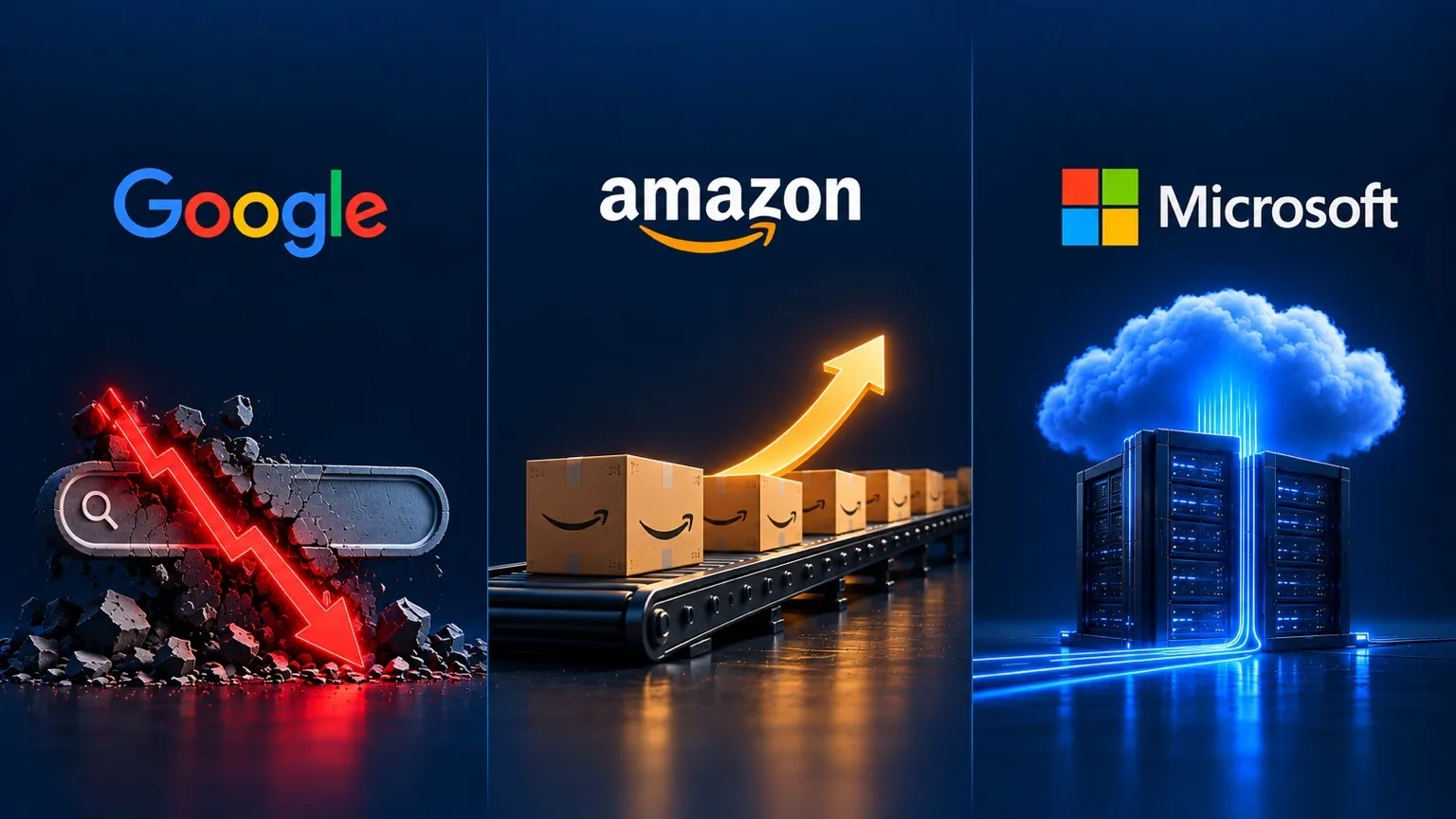
Alphabet’s cloud business doubled in size last quarter, and the shares had their worst day since the company listed in 2004.
For a sense of why a strong quarter can land badly, our video takes four companies and asks what actually keeps a profit margin safe. Watch it first to better understand this week’s stories: MSCI, Moody’s, Microsoft: What Their Margins Actually Mean at Global Markets by Vested.
Alphabet grew revenue 25% and cloud revenue 103%, but lost about $482 billion of market value in a single session.
Microsoft reported Azure growth of 48%, spent nearly $5 billion less than it had guided investors to expect, and the stock barely moved.
Amazon hit the best operating margin in its history and bought $77 billion of property and equipment in three months.
Quite an interesting week!
Before we dive into the stories, let’s see how the world’s markets held up this week.
The World in a Week

Amazon and Alphabet missed expectations, and Intel had its worst day since 1974 after a weak outlook. Investors are now asking when all the money spent on AI will start paying back.
Tech stocks took the hit. The Nasdaq fell 2.0% to 25,437.00 and the S&P 500 slipped 0.6% to 7,580.07. The same worry spread to Chinese chip and AI stocks, and the SSEC fell 2.5% to 3,599.02.
The Fed held rates on Wednesday, but two officials voted for a hike, and traders now expect one in December. Gold, which pays nothing to hold, fell 2.5% to $3,897. Bitcoin dropped 5.2% to about $77,000 after a $6.3 billion hack at the crypto exchange Binance.
Oil stayed expensive. Tanker attacks near the Strait of Hormuz kept Brent crude above $110 a barrel.
India went the other way. IT and pharma stocks led, and the Nifty 50 rose 2.0% to 23,053.10. The rupee firmed on Friday as the dollar weakened. But with oil above $110, India’s import bill stays high.
News Stories
Alphabet’s best revenue quarter, worst single-day fall
On Wednesday evening, Alphabet reported the best revenue quarter in its history, and by Thursday’s close the shares were down 12.64% at $283.82.

Source: GOOGL on Vested
About $482 billion of market value went with it. That is Alphabet’s worst day since it listed in 2004.
Only Nvidia has lost more in a session, $593 billion in January 2025.
Revenue rose 25% to $127.6 billion and operating profit rose 30% to $40.6 billion.
Google Cloud revenue doubled to $30.7 billion, and its order book reached $561 billion.
What fell was profit per share, from $2.87 a year ago to $2.12. Analysts had expected about $3.02.
The gap came from, in its CFO Anat Ashkenazi’s words –
“Other income and expenses was negative $8.2 billion, due primarily to unrealized loss from our investment in SpaceX”
Alphabet has held SpaceX shares for years. SpaceX is now listed, its share price fell, and accounting rules require Alphabet to book that fall as an expense.
No money left the company, and the loss reverses if SpaceX recovers.
Then the part that did involve money. Alphabet spent $51.4 billion on buildings, chips and equipment in three months, against $24 billion in the same quarter last year.
That is more than the $42.3 billion the business generated in cash. CFO Ashkenazi put the result in one sentence –
“We had negative free cash flow of $9.1 billion in the third quarter, driven by our investments in CapEx.”
Free cash flow is the money left after running the business and paying for equipment. It has now been negative two quarters in a row, and Alphabet expects to spend more next year.
Search was the other worry. Revenue there grew 12% to $63.4 billion, slower than the 17% of the previous quarter. Chief business officer Philipp Schindler blamed currency first, then added –
“[…] the strong growth in AI Mode queries had an impact because of the lower monetization”
AI Mode answers a question directly on the page, where ordinary results give you a list of links. Each AI Mode search earns Google less, and it is the part growing fastest.
Jeffrey Wlodarczak of Pivotal Research put it like this –
“The bears will argue this is the first quarter that AI is starting to seriously hurt their search business”
We covered Alphabet’s quarterly earnings in detail on our latest blog: Alphabet Q3 2026 earnings: AI boom meets a cash crunch.
Microsoft’s strong quarter couldn’t hold gains for long
Microsoft reported the same evening as Alphabet, and the two were received very differently.
Its shares jumped close to 3% in after-hours trading, then gave the gain back and closed Thursday almost unchanged at about $530.

Source: MSFT on Vested
The growth was there. Revenue reached $92.3 billion, up 19%, and operating profit $45.9 billion, up 21%.
Azure, the cloud division, grew 48% to $33.2 billion. Microsoft had told investors to expect 44% to 45%, and it has now guided to 49% or 50% for the December quarter.
The order book is the largest number in the whole report. Contracted work Microsoft has not yet delivered stood at $677 billion, up 73%.
Finance chief Amy Hood described the constraint on the call –
“Customer demand continues to exceed available supply.”
Here is where Microsoft parted company with Alphabet. It had guided to capital spending above $50 billion for the quarter and actually spent $45.2 billion.
Some of that was choice and some of it was timing. Computing power Microsoft rents from other companies arrived late, so that spending moves to later in the year.
About three-quarters of what it did spend went on processors and graphics chips. Chips last a few years, so they have to earn their money back fast.
Either way, the money stayed in the company. Microsoft brought in $18.6 billion of free cash flow in the quarter, when analysts had expected about $8.5 billion.
For context, Alphabet’s free cash flow was minus $9.1 billion. Microsoft is building at much the same scale and still paying for it out of what it earns.
Chief executive Satya Nadella was asked about returns on all this spending –
“I’ve never been more confident in the long-term returns for our investments.”
One number in the release argues with him, and it deserves saying out loud. Commercial bookings, which measure new contracts signed, fell 12%.
Hood put that down to the size of the Azure commitments signed a year earlier. That is a fair explanation, and also a reminder that a year-on-year comparison depends entirely on what sits behind it.
The underspending is unlikely to repeat. Hood told investors to expect capital spending back above $50 billion this quarter, and Microsoft now plans around $170 billion for the calendar year.
We covered Microsoft’s quarterly earnings in detail on our latest blog: Microsoft Q1 FY27 results: revenue jumps 19% to $92.3 billion as Azure grows 48%.
Amazon’s best-ever margin, but a 10% drop in share price
Amazon reported on Thursday after the American market closed, and it had the strongest quarter of the three on almost every operating measure.
Net sales were $201.9 billion, up 12%. Operating profit reached $28.1 billion against $17.4 billion a year earlier, which works out at a 13.9% margin, the highest the company has recorded.
Amazon Web Services grew 39% to $46 billion and produced $17.8 billion of that profit on its own. Chief executive Andy Jassy allowed himself a forecast –
“There has never been a trillion dollar revenue business, and we may have two of them in the next 5-10 years.”
The shares fell anyway, about 4% in the session and roughly 6% more after the results landed.

Source: AMZN on Vested
The reason sits two pages into the release.
Amazon bought $77.3 billion of property and equipment in the quarter, against $35.1 billion in the same quarter last year.
Its free cash flow over the past twelve months was an outflow of $42.4 billion. A year of selling almost everything to almost everyone, and the cash account went backwards.
Worth being precise here. An outflow is not the same as a loss, and Amazon earned $20.7 billion of net profit in the quarter. The money has gone into warehouses, chips and data centres that will be there for years.
It has still left the company. Amazon expects to spend around $220 billion of cash on capital this year.
The bottom line
How do you price something while it is still being built?
For most of this year the market answered by looking at growth, and growth kept arriving. This week it looked at the cash instead, and found three different answers in the same industry on the same evening.
Capacity built ahead of demand always shows the bill before it shows the return. The awkward part is that nobody can tell you in advance how long that gap lasts.
What would it take for you to stop checking a company’s cash flow every quarter?
That is a story for a future Vested Shorts. We will be here to tell you when it comes.
Thanks for reading!