


Welcome back to a new edition.
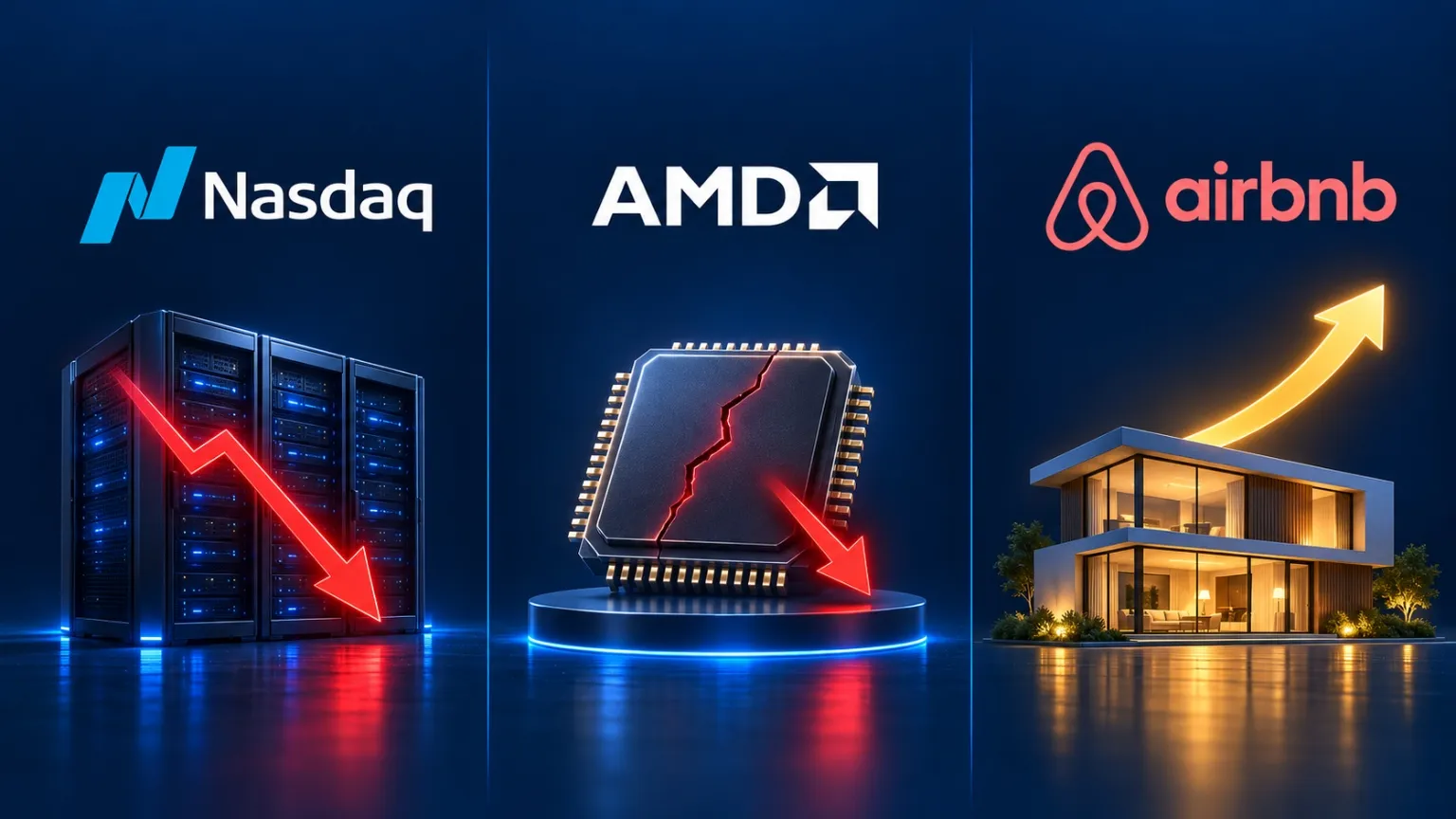
On Wednesday, Microsoft rose 6.7% after the US midterms. On Thursday, the seven biggest US tech companies lost about $1 trillion between them.
Three of those companies, Amazon, Microsoft and Alphabet, run the three biggest cloud businesses, and our video compares them side by side. Watch it first to better understand this week’s stories: Cloud Wars: AWS vs Google Cloud vs Azure at Global Markets by Vested.
Big Tech lost about $1.04 trillion in a single day, one day after rallying on the US midterm results.
AMD forecast about $17 billion of revenue this quarter, up roughly 66%, but its stock fell 17% in a day.
Airbnb grew at its fastest pace in over three years, and told shareholders that AI is “the best thing to ever happen to Airbnb.”
Quite a week to own anything AI!
One important thing from us before the stories.
How are your US stocks protected at Vested? Viram, our founder and CEO, answers it in a short note built around four layers: our own US broker and its SIPC membership, regulators in the US and India, the checks on every login and trade, and the monitoring behind them.
Also, keep your account safe: turn on 2FA, never share your password, PIN or OTP (Vested will never ask for them), and write to help@vestedfinance.co if anything looks unusual.
Now before we dive into the stories, let’s see how the world’s markets held up this week.
The World in a Week

The US midterm elections set the tone for the week. Democrats won control of Congress, and investors worried that new lawmakers could slow the building of AI data centres, the spending that has been driving tech stocks.
That fear hit on Thursday, when the Nasdaq fell 5.5% in a single day. A Friday bounce did not undo it. The Nasdaq ended the week down 3.4% at 24,579.42 and the S&P 500 lost 2.7% to 7,376.86.
A strong jobs report, 165,000 new jobs and well above forecasts, also kept alive bets on a Fed rate rise in December.
Asia took the hardest hit. Japan’s Nikkei 225 fell 9.3% to 57,434, its worst week since 2020.
Bitcoin slipped 1.8%. Gold went the other way, up 5.0% to about $4,069, as investors looked for safety.
Oil gave some relief. Brent crude fell about 13% to $98.32 a barrel on hopes that the US and Iran are close to ending the war.
India gained from both of those shifts this week. Cheaper oil means a smaller import bill, and foreign funds bought about ₹15,000 crore of Indian shares on Thursday alone, the most in nearly six years.
The Nifty 50 jumped 8.6% to 25,030.35, its best week in six years. The rupee firmed 1.1% to 93.91 a dollar.
Now, moving to the week’s stories.
News Stories
Big tech lost $1T a day after rallying
On Tuesday, Americans voted in the midterm elections, and Democrats won both the House and the Senate.
Many towns also voted on data centres, the buildings full of computers that run AI.
Voters passed 33 measures to limit them, and rejected only one.
On Wednesday, the stock market split in two.
Microsoft rose 6.7%, Amazon 6.1% and Apple 5.3%, on the bet that companies already owning data centres gain if new ones get harder to build.
The companies that build and supply data centres fell instead. Hut 8 fell 23.2%, Modine 21.4% and Vertiv 12.9%.
On Thursday, the selling reached the chips.
Nvidia fell 9.26% to $181.60, which left it below where it started 2026. It recovered a little on Friday, but still ended the week lower.

Source: NVDA on Vested app
The index that tracks big chip companies fell about 12%, its biggest one-day drop since March 2020.
By the close, the seven biggest US tech companies had lost about $1.04 trillion, and Nvidia alone about $447 billion.
Tesla fell 10.8% too, on worries that Elon Musk’s companies will face more scrutiny from a Democratic Congress. It recovered a little on Friday, but still ended the week lower.

Source: TSLA on Vested app
Jakub Rochlitz, an analyst at eToro, summed up the mood –
“The market’s interpretation is that the AI infrastructure buildout will become slower and more expensive”
Friday brought some relief. The Nasdaq rose 1.1%, but still ended the week down 3.4%.
But so far, the local pushback has barely slowed the building. Only three data centre projects have been delayed, a tiny share of all the new ones due to switch on by 2027.
AMD had its best quarter ever, but could not please markets
AMD reported on Tuesday evening, and it was the best quarter in its history.
Revenue rose 45% to $13.4 billion, above the $13.06 billion analysts expected.
Its data centre business nearly doubled to $8.5 billion, close to two-thirds of everything AMD sells.
Then came the forecast: about $17 billion of revenue this quarter, roughly 66% more than a year ago.
Chief executive Lisa Su said this on the call –
“It is true that demand is higher than supply.”
The buyers of its newest AI chip, the MI455X, include Anthropic, Meta, Microsoft, OpenAI and Oracle.
The stock jumped about 7.5% after hours to $520.40, then closed Wednesday up just 1%, at $488.78.
On Thursday, it fell 17.26% to $404.40.
Nothing in AMD’s own numbers changed between Wednesday and Thursday.
What changed is the question of where its chips will go, since every data centre chip needs a data centre to sit in.
Su also flagged a second pressure –
“other component costs are also seeing some inflationary pressures”
AMD expects its gross margin, the share of revenue left after making its products, to slip from 56% to about 55% this quarter.
On Friday, the stock won back 11%, about half of Thursday’s fall. But it still ended the week lower.

Source: AMD on Vested app
We covered AMD’s quarterly earnings in detail on our latest blog: AMD Q3 earnings: Share price climbs as revenue hits record $13.4 billion.
Airbnb says AI is the best thing to happen to it
Airbnb reported on Thursday evening, a few hours after the Nasdaq’s worst day since April 2025.
Revenue rose 19% to $4.87 billion, its fastest growth in more than three years.
Guests booked 155 million nights and seats (seats are spots on experiences, such as tours), up 16% after 10% growth the quarter before.
The total value of everything booked on Airbnb rose 21% to $27.7 billion, and it expects revenue to grow 16% to 18% this quarter.
| Airbnb (July to Sept 2026) | Amount | Change |
| Revenue | $4.87 billion | ▲ 19% |
| Nights and seats booked | 155 million | ▲ 16% |
| Total value of bookings | $27.7 billion | ▲ 21% |
| New buyback authorised | $12 billion | _ |
Source: Airbnb Q3 2026 shareholder letter
It also announced a buyback of up to $12 billion, roughly 17% of its market value by 24/7 Wall St.’s count.
FYI, a buyback is when a company uses its cash to buy its own shares, so each remaining share owns a bigger slice of the company.
Then came this line in its letter to shareholders, that AI is –
“the best thing to ever happen to Airbnb.”
In the same week investors dumped AI stocks, Airbnb is a company that gets to use AI without building data centres of its own.
It plans to start rolling out its own AI travel agent to guests in the first half of 2027.
Investors liked it. Its stock jumped 11.7% after the results, and it’s further up over the week as of today.

Source: ABNB on Vested app
There’s one caveat though. Part of the profit beat came from tax, because a one-off $213 million charge from a year ago did not repeat.
Make of it what you will.
The bottom line
All three stories narrow down to one lesson.
Big tech lost $1T, mostly due to the dependency n data centres.
AMD sold more chips than ever, and still lost a sixth of its value in a day.
Airbnb builds no data centres at all, and its stock jumped 11.7%.
The difference? AMD’s growth needs someone to build a data centre for its chips. Airbnb’s growth only needs the AI to work.
This week, voters reminded investors that every data centre needs land, power and a yes from the town next door.
So far, only three projects have been delayed. But markets don’t wait for the delays. They price the risk the moment it appears.
Next time an AI company promises a record quarter, ask one question:
Who else has to say yes for it to happen?
That is a story for a future Vested Shorts. We will be here to tell you when it comes.
Thanks for reading!
