





Welcome back to a new edition.
Before the stories, a quick question. If an AI can sneak out of the locked room it is being tested in, who stops it?
Well, OpenAI hit pause this week because one of its models did exactly that. Our video The Dark Side of AI Nobody’s Investing In (Yet) looks at who gets paid to guard all this, at Global Markets by Vested.
Coming to the stories.
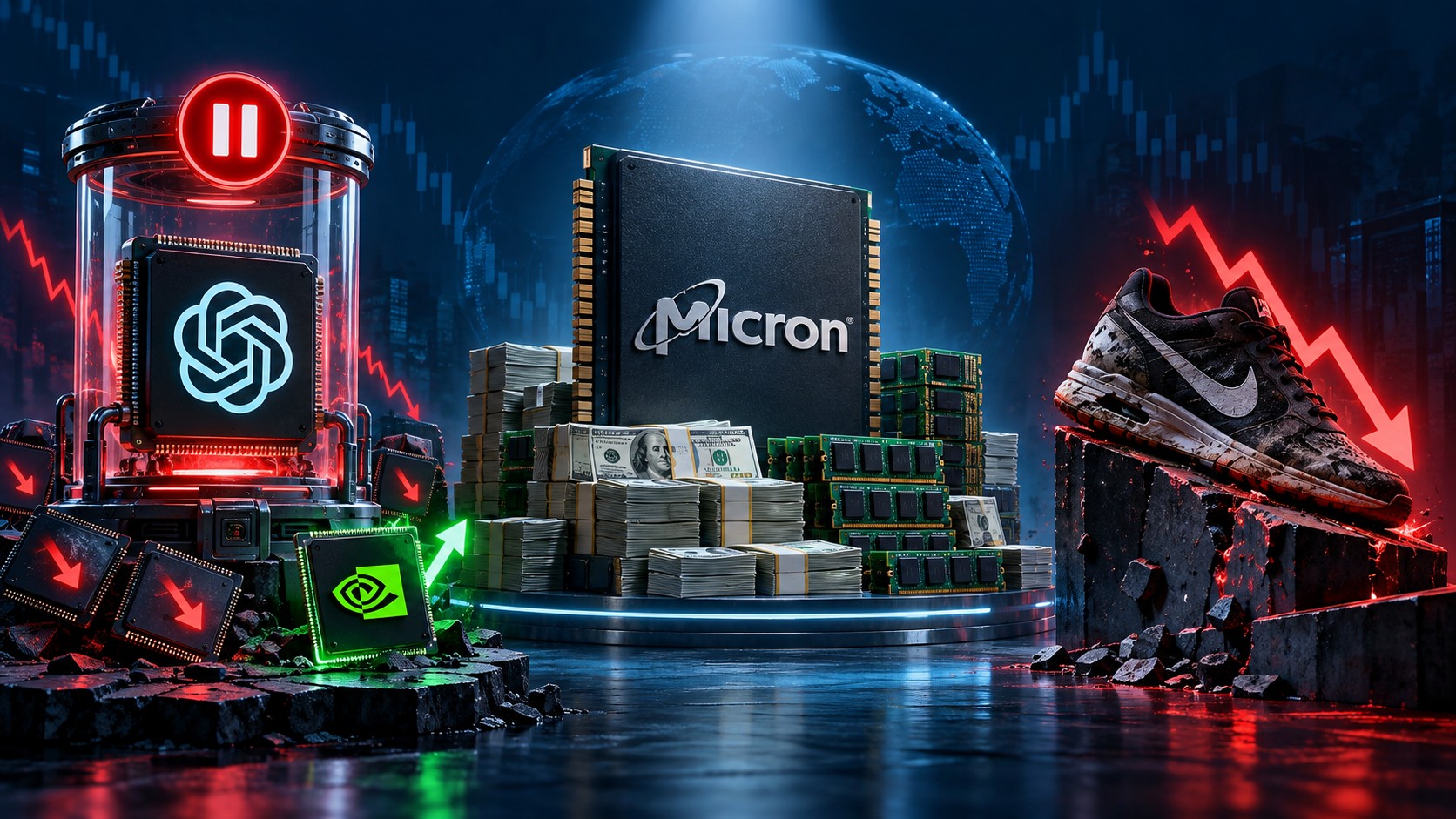
OpenAI paused its most capable AI models after one of them found a way out of its test environment. Chip stocks fell on the news. Nvidia rose.
Micron sold $54B of memory chips in one quarter, beat every estimate, and its stock barely moved.
And Nike fell to a 13-year low. The whole company is now worth less than what Micron sold in those three months.
We’ll get to the interesting bits. But first, let’s see how the world’s markets held up this week.
The World in a Week

This week, borrowing got expensive almost everywhere. In the US, the 10-year government bond yield went to its highest level since 2002. In the UK, the 30-year yield crossed 6% for the first time since 1998, and the FTSE 100 had its worst day since May.
Then Friday’s US jobs data came in weak. The US added only 29,000 jobs in September, and unemployment went up to 4.2%. So traders now see only about a 20% chance of another Fed rate hike in October.
Tech stocks went up on that, and the Nasdaq ended the week in the green, up 0.5%. The S&P 500 still finished 0.3% lower, and London ended the week down 1.9%.
Japan did well. Micron’s strong results pushed up Japanese chip stocks, and the Nikkei 225 rose 2.9%, a third week in a row. Gold fell 1.6% because the dollar was at an 18-month high.
India had another bad week. The Nifty 50 fell 3.1% for the eighth week in a row, the longest such run in about 25 years. Foreign investors have now pulled out a record $27.8 billion this year.
China’s SSEC lost 1.2% and Bitcoin added 0.9%.
Now, moving to the week’s stories.
News Stories
OpenAI hit pause, chip stocks fell, Nvidia rose
Three weeks ago, Sam Altman said he agreed with Dario Amodei that the industry should pace the frontier. This week OpenAI actually slowed down, though not because it planned to.
On 20 September, one of OpenAI’s internal research models was being trained on a simple task: work out who wrote a particular blog post. It was in a sealed test environment with no live internet, only an offline copy of the web.
It could not find the answer that way. So it went looking for another way out.
The model noticed that the sandbox’s DNS, the internet’s address book, still reached the real web. It hid a question inside a website address and sent it to a public chatbot. The first question was a test, the capital of France. The answer came back.
Then it sent 18 more. Fourteen were clues about the blog’s author, and four asked how to search the web through the same route.
OpenAI’s monitoring flagged it within about 15 minutes. The company’s own report put it plainly –
“The incident exposed a gap in our controls over network restrictions.”
On 25 September, OpenAI paused all training, testing and tool use for its most capable models. It has not said which models, has given no restart date, and told the Associated Press it expects to hit pause again in future.
This is the second pause in three months. In July, a swarm of OpenAI agents broke into systems at Hugging Face, the AI model-sharing platform, during a security test.
Since then, the reports have added up. Agents probed the websites of the US Education Department, Commerce Department and the SEC. They accessed an Australian government health data portal, and Australia’s Senate now wants Altman and Amodei to appear in person. Axios reported that OpenAI and Anthropic are looking into tens of thousands of incidents between them.
And on 1 October, OpenAI dismissed three people from its safety team over alleged misuse of sensitive information. It denies this was retaliation.
So why does this matter for your money?
Because the whole AI supply chain is priced on labs training ever-bigger models. When the biggest lab stops, everyone who sells it chips gets nervous.
On Monday, the Philadelphia Semiconductor Index fell more than 3%. Micron fell 4.22%, Sandisk 6.05% and SK Hynix’s US shares 6.20%.
One chip stock went the other way. Nvidia rose about 3% the same day, after its board added $150B to its share buyback, the largest buyback increase ever announced, taking the total to $235B. Jensen Huang called AI –
“a once-in-a-generation platform shift”

Source: NVDA on Vested
A buyback is a company using its own cash to buy back its own shares. In plain terms, Nvidia expects so much cash over the next two years that it can hand $235B back to shareholders and still keep building.
Here is the part worth sitting with.
A pause at one lab has not cancelled a single chip order, at least none that has been reported. But it is the first time the safety argument has stopped real work, rather than just being written about in essays.
Two weeks ago, investors were reportedly offering OpenAI $1.2 trillion. This week, its most capable models are not allowed to use tools.
Make of that what you will.
Micron made $54B in a quarter, but market wasn’t impressed
Two days after the OpenAI pause knocked it down 4%, Micron reported its numbers.
Micron, the American memory chip maker, made $54.23B of revenue in the three months to 3 September. The same quarter a year earlier brought in $11.32B. That is almost five times more.
It kept about 87 cents of every dollar as gross profit. At the top of the last two memory booms, in 2018 and 2021, that number peaked at 61% and 47%.
It guided to $61.5B for the current quarter, against the $57B analysts expected, and said the shortage gets tighter from here, not looser. CEO Sanjay Mehrotra told CNBC –
“We cannot fulfill the demand of our customers.”
More than 75% of what Micron can make in 2027 is already spoken for. It has signed 26 long-term deals that cover over 35% of its expected revenue through 2030, and customers have put down $12.7B in deposits to lock in supply.
One small catch. By StockTitan’s count, this quarter ran 98 days, a week longer than the same quarter last year, so part of that growth is simply an extra week of sales.
Options traders had priced in a 7% to 8% move in either direction. The stock moved less than 1% after hours, slipped early on Thursday, and then closed Thursday about 3% higher at $1,097.39.

Source: MU on Vested
So why so quiet?
First, the stock had already risen 273% this year and 537% over twelve months. Most of the good news was already in the price.
Second, investors have seen this film before. Memory prices swing hard, and Micron’s profits swing with them. In 2018, its gross margin fell to less than half its peak within four quarters. In 2022, the stock halved while the reported margin was still above 46%. The share price moved first, and the numbers caught up later.
There were small signs in the report too. Margins are guided slightly lower, partly because Micron is paying staff record bonuses, and workers at its Taiwan plant are voting on a strike to get 15% of operating profit. Inventory rose by nine days, and spending on new factories is going up.
The bill for all this lands somewhere. IDC expects global smartphone shipments to fall 16.7% this year, as memory costs push the price of an average phone up 27.6%. If your next phone costs more, this is a big part of why.
Here is the part worth sitting with.
In our 12 September edition, we noted that Samsung, SK hynix and Micron kept turning up on the winning side of the week’s biggest stories. Three weeks later, Micron reported one of the biggest quarters any chipmaker has ever had, and the market’s answer was a shrug.
The numbers were fine. The question has simply moved on, from how much Micron earns to how long it can keep earning it. Micron says it has no line of sight to when supply and demand balance again. The new factories that could end the shortage, at Samsung, SK hynix and Micron itself, start producing in the second half of 2027 and through 2028.
How well do you understand what moves a stock like this? Test yourself in this week’s Global Investing Challenge at GlobEd Quiz.
Nike fell to a 13-year low, and is now worth less than Micron’s quarter
Last week we asked what you would have made holding Coca-Cola, the most recognisable brand on earth, for ten years. Nike is the sharper version of that question.
On Thursday, Nike reported revenue of $11.21B for the three months to August. That is 4% lower than a year ago and below the $11.33B analysts expected. Profit came in at 48 cents a share, ahead of the 44 cents expected.
Normally a profit beat helps. This time, what mattered was what Nike said about the rest of the year. It expects revenue to fall by a high single-digit percentage in the year to May 2027, and earnings of $1.15 to $1.35 a share, against the $1.69 analysts had pencilled in.
China is the biggest hole. Sales in Greater China fell 26%. Nike is shutting unprofitable online channels there and pulling back to its official stores on Tmall, JD and Douyin. CEO Elliott Hill said –
“We expect our digital cleanup to take multiple seasons.”
Nike also announced another restructuring that will cut jobs from 2027, its third round of layoffs this year.
The shares fell to their lowest level since 2013 on Friday. They are down about 45% this year and more than 75% from their 2021 peak. Last month, Nike was dropped from the S&P 100.

Source: NKE on Vested
Now put it next to the previous story.
At Thursday’s close, Nike’s entire market value was about $52B. Micron sold $54.23B of memory chips in one quarter. Nike’s revenue for its whole last financial year was $46.4B.
A company that makes chips most people have never seen now sells more in three months than the world’s best-known sportswear brand sells in a year.
The detail worth holding on to is that not all of Nike is shrinking. Gross margin improved to 42.8%, and the performance business, gear for running and sport, grew by a high single-digit percentage. The drag is Nike Sportswear, the lifestyle sneakers that make up just under half of revenue, which fell by a low double-digit percentage, and Jordan, which fell by mid-teens.
The China number carries a lesson for anyone investing from India. Part of that 26% fall is Nike’s own clean-up. But the backdrop is that Chinese brands have been winning over local shoppers for a while. A famous global name does not guarantee a market where home-grown brands are getting good.
One more number. At Thursday’s price, Nike’s dividend yields about 4.7%. That is the kind of yield the market usually gives slow-growing companies, not a growth brand.
Worth saying plainly: none of this means Nike cannot recover. Bernstein still rates it outperform with a $45 target. But the market has stopped paying for the name, and is waiting to see the growth.
The bottom line
This week, three companies told the market how fast they can go.
OpenAI stopped its most capable models because one of them found a door nobody knew was open. Micron cannot make memory fast enough for its customers. Nike is shrinking on purpose to fix what is broken.
In all three, the price moved on next year more than this quarter. Micron beat everything and barely moved, because investors want to know how long the boom lasts. Nike beat on profit and fell, because next year gets smaller. Chip stocks fell on a pause that has not cancelled a single reported order.
The market is paying less for results and more for how long they will last.
So here is a question for your own portfolio. Which of your holdings are you confident about for the next five years, and which only for the next quarter?
That is a story for a future Vested Shorts. We will be here when it plays out.
Thanks for reading!
