 Skip to content




Welcome back to a new edition.
This week was a nice reminder of what Ice hockey legend Wayne Gretzky once said:
“I skate to where the puck is going to be, not where it has been.”
Except, this week… the markets played hockey.
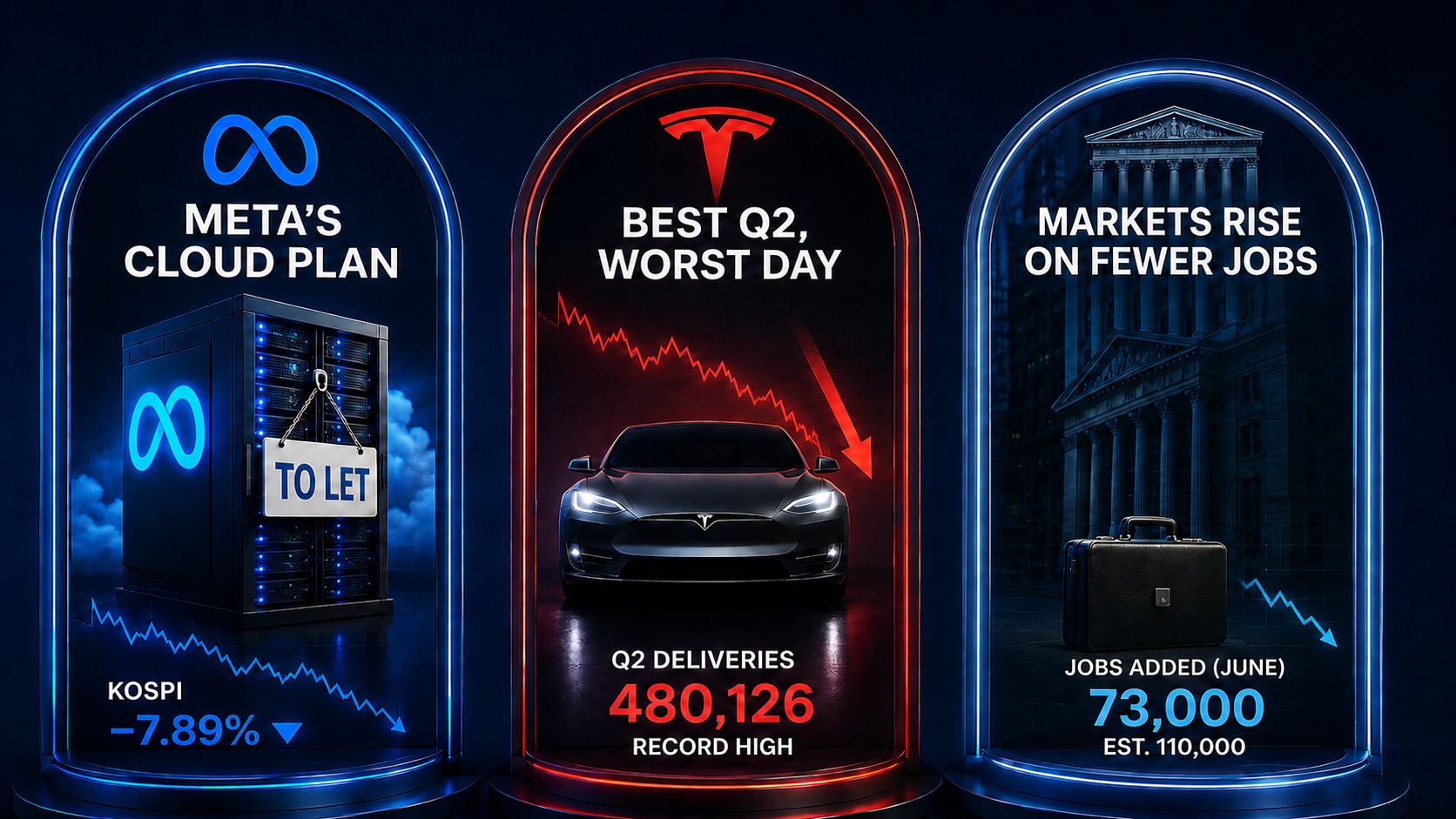
Tesla posted its best Q2 ever and had its worst day in a year.
Meta found a way to earn money from spare computers, and South Korea‘s stock market fell. Again.
Then, America added half the jobs everyone expected. And Wall Street? Celebrated.
None of this makes sense if you look at what happened. All of it makes sense if you look at what comes next.
We’ll get to the interesting part. But first, let’s look at the week’s market updates.
The World in a Week: How Major Markets Moved
Chip stocks roughly doubled in the second quarter. This week, they got their first real gut-check. Yet every single row on the scoreboard closed green.
Money did not leave the market. It just changed its mind about where in the market it wanted to be.
United States:The chip selloff had two triggers: reports that OpenAI is in early talks to sell a 5% stake to the US government, and Meta flagging it may rent out its excess computing power. Both spooked the belief that AI spending only goes up, dragging down Micron and AMD, while the Dow hit records as money rotated into steady stocks. A soft June jobs report counterintuitively cheered stocks by easing the pressure on Kevin Warsh’s inflation-focused Fed to raise rates. More on this in the full story below.
Japan:AI-linked names like Kioxia fell with the global chip mood, but the Nikkei still scraped a green close at 0.19%.
Commodities and crypto:Oil drifting toward $68 a barrel as the Iran conflict cools is now the cleanest path to lower inflation. Gold rose 2.45% to $4,175.69 and Bitcoin climbed 3.82% to $62,462, both riding the week’s broad green.
The tell of the week: the AI trade cracked, and the scoreboard did not even notice.


News Summaries
Meta’s side hustle upsets the market
On July 1, Bloomberg reported that Meta is building a cloud business to sell its excess AI computing power to outside customers.
Meta’s stock jumped about 8.8% to $612.91.
The scale explains the excitement.
Meta plans to spend as much as $145 billion this year on data centres and AI chips. Mark Zuckerberg had hinted at this in May, telling shareholders a cloud business was “definitely on the table.”
*Note: this is a reported plan, not a launched product. No pricing, timeline, or customers have been announced.
Meta’s shares jumped on the news, but fell about 5% the next day.

Further, Wall Street chipmakers fell overnight. Micron fell more than 10% and the Nasdaq dropped, even as the Dow climbed, a split that showed money was not leaving stocks, just leaving the AI trade.
The next morning, South Korea took the harder hit, driven by its two heavyweights.
On July 2, South Korea’s KOSPI fell 7.89% to 7,648.09, a drop steep enough that regulators triggered a trading halt. SK Hynix fell 14.57% and Samsung dropped 9.06%, and those two companies alone now make up more than half the index. Foreign investors reportedly sold more than 5 trillion won (South Korea’s official currency) of Korean stocks in one day.
Here is what is actually happening.
For three years, chip stocks have been priced on one belief: AI demand is endless and supply can never catch up.
Meta selling spare capacity turned that belief into a question. One of the world’s biggest AI buyers just signalled it may have more computers than it needs.
Think of a city where everyone believes flats will always be scarce. Prices climb for years, then the biggest buyer in town puts up a To Let board. Nothing about the flats changed, the belief did.
However, the panic may well be misplaced.
Research firm SemiAnalysis called the panic “erroneous” and said Meta’s chip buying will accelerate, not slow down.
For three years, the AI trade priced scarcity. This week, Meta advertised a vacancy.
The India-lens: Every Indian investor watching chip stocks this week had the same two thoughts, in this order: glad I am not fully in, and wait, is this the dip everyone talks about? Buying a crash feels smart, but a big drop alone does not make a stock cheap. The real question is whether chip demand is actually slowing or the market just panicked. We asked exactly that in our latest video, and tried to share some logic on is it too late to buy semiconductor stocks today?
Watch on YouTube
Tesla’s best Q2 ever, worst day in a year
On July 2, Tesla reported 480,126 vehicle deliveries for the second quarter, up about 25% from a year earlier and its best second quarter ever.
Wall Street was expecting around 406,600. Tesla beat that by roughly 74,000 vehicles.
But… the stock fell about 7.49%, its worst day in almost a year.

Source: Yahoo Finance
This was not a one-off mood swing. Tesla’s stock has now fallen after each of its last three quarterly delivery reports.
Analysts argue Tesla’s roughly $1.6 trillion valuation now rests largely on its robotaxi and Full Self-Driving story rather than car sales.
The next test comes fast. Tesla reports full second-quarter results on July 22, and investors are focused on what the record deliveries did to profit margins.
Anyways, here is the part worth sitting with.
This is the school topper problem. Score 99 out of 100 and nobody claps, because 99 was expected of you. Much of Tesla’s record had been awarded marks days before the results came out.
So the report just confirmed a widely held prediction and moved the question to the next thing: margins, robotaxis, the July 22 numbers.
When everyone expects a record, the record stops being news.
When a stock rises before the news, the news sometimes becomes the exit.
The India-lens: Every Indian investor has done this at least once: bought a stock right after great news, watched it fall, and wondered what they missed. Often, the price already contained the news, so they were paying for the past. Results tend to move stocks when they differ from expectations, and weeks like this prove the perfect entry is mostly luck dressed up as skill. So don’t wait for the right moment, there isn’t one. Tesla and 10,000+ US stocks are available directly from India through Vested.
Invest in US Stocks
Wall Street’s party, sponsored by fewer jobs
On July 2, the US reported just 57,000 new jobs for June, far below the 115,000 that economists expected. April and May were also revised down by a combined 74,000 jobs.
And yet the unemployment rate fell to 4.2%, its lowest in a year.
The catch: the rate only counts people looking for a job, and in June, more Americans simply stopped looking. The share of Americans working or job-hunting fell to 61.5%, the lowest since March 2021.
So the number improved largely because fewer people were trying, not because more found jobs.
Anyways, how did markets react to a weak jobs report? The Dow jumped 539 points to close at a record 52,844.
Everyone be asking to the markets –

Well, here is what almost nobody is talking about.
Markets were not celebrating the economy. They were celebrating what the Fed might now not do.
When inflation runs hot, the Fed raises interest rates to deliberately slow the economy. New Fed chair Kevin Warsh had been signalling rates may need to rise this year. And stock markets hate rate hikes, because costlier borrowing squeezes company profits.
Thursday flipped the threat. A weak jobs report means the economy is slowing on its own, so the Fed may not need to hike rates. After Thursday’s number, futures markets stopped pricing in a September hike, though October remains possible.
That is also why the opposite happened four weeks ago: the US added 172,000 jobs in May, nearly double expectations, and markets fell.
Same Fed, same logic, opposite direction.
Currently, it’s like the class celebrating when the strictest teacher cancels a surprise test. The syllabus did not get easier. The threat just got postponed.
Which raises the uncomfortable question inside the celebration: a slowing job market is good news for interest rates, right up to the point where it becomes bad news for company profits. Nobody knows where that line sits.
Wall Street was not cheering 57,000 jobs. It was cheering a rate hike getting harder to justify.
The India-lens: You have seen this at home: the US Fed raises rates, and suddenly “FIIs pull out ₹X crore” headlines appear, the rupee slips, and your Indian portfolio dips for no Indian reason. The link is simple: when US rates rise, big investors can earn more safely in America, so money leaves markets like India. This week, with hikes less likely, that pressure eased. And that slipping rupee quietly changes what your global investments are worth. How? Find out on GlobEd by Vested.
Explore the module
Now step back and look at all three together.
Meta’s spare computers shook a stock market an ocean away. Tesla broke its own record and got punished for it. America’s economy slowed, and Wall Street hit a record high.
One thread runs through it all: nobody was trading this week’s news.
They were trading next year’s chip demand, next quarter’s Tesla margins, and the Fed’s next meeting.
Like the hockey legend once said, the game lives where the puck is going, not where it has been.
Which leaves the one question this week didn’t answer:
When everyone is betting on the same future, what happens if it does not arrive?
For Indian investors, the fix is refreshingly boring: you already know it from your SIPs.
Invest regularly, spread your bets, and let time do what timing cannot.
Before we close for this week, we have an exciting update for you.
Your FY 2025-26 tax documents are now live on Vested! Get all tax documents for your entire Vested portfolio: Stocks, ETFs, Global Funds, Managed Portfolios and Private Markets, all in one place.
You can also file your ITR directly from Vested with ClearTax and enjoy an exclusive offer of up to 70% off using code CTVESTED.
Just go to your Profile. Then click on Tax Documents.

