Welcome back to a new edition.
On Thursday, Jensen Huang resigned as Nvidia’s chief executive. Interestingly, a day later, SK hynix, a memory chip maker in Korea, lost about $21 billion of value.
Two chip companies went the other way. AMD and Broadcom rose almost 6% each on Thursday, on bets that some of Nvidia’s orders could move to them.
Our video tests how strong Broadcom’s position really is. Watch it first to better understand our first story: The Moat Test: Is Broadcom Actually Unbeatable? at Global Markets by Vested.
Nvidia lost its founder, and companies from Korea to Ohio that depend on it moved with it. But which way, you ask? That’s the story.
The other story is how SoftBank lost $7.1 billion in a quarter, after writing off $3.7 billion it paid for power equipment for AI data centres.
And the third, Anthropic asked investors for up to $64.4 billion, but got orders for about six times the shares on offer.
One thing from us before the stories. Nvidia reports its results on Tuesday. If you wish to test the waters, check your understanding of how to read US earnings in the Global Investing Challenge by GlobEd.
Now before we dive into the stories, let’s see how the world’s markets held up this week.
The World in a Week
Inflation set the tone. US consumer prices rose 0.4% in October, more than expected, and producer prices were up 6.5% on the year, the most since 2022.
Traders now put the odds of a Fed rate hike in December at about 89%. The US 10-year Treasury yield, what the US government pays to borrow, climbed to 5.17% on Friday.
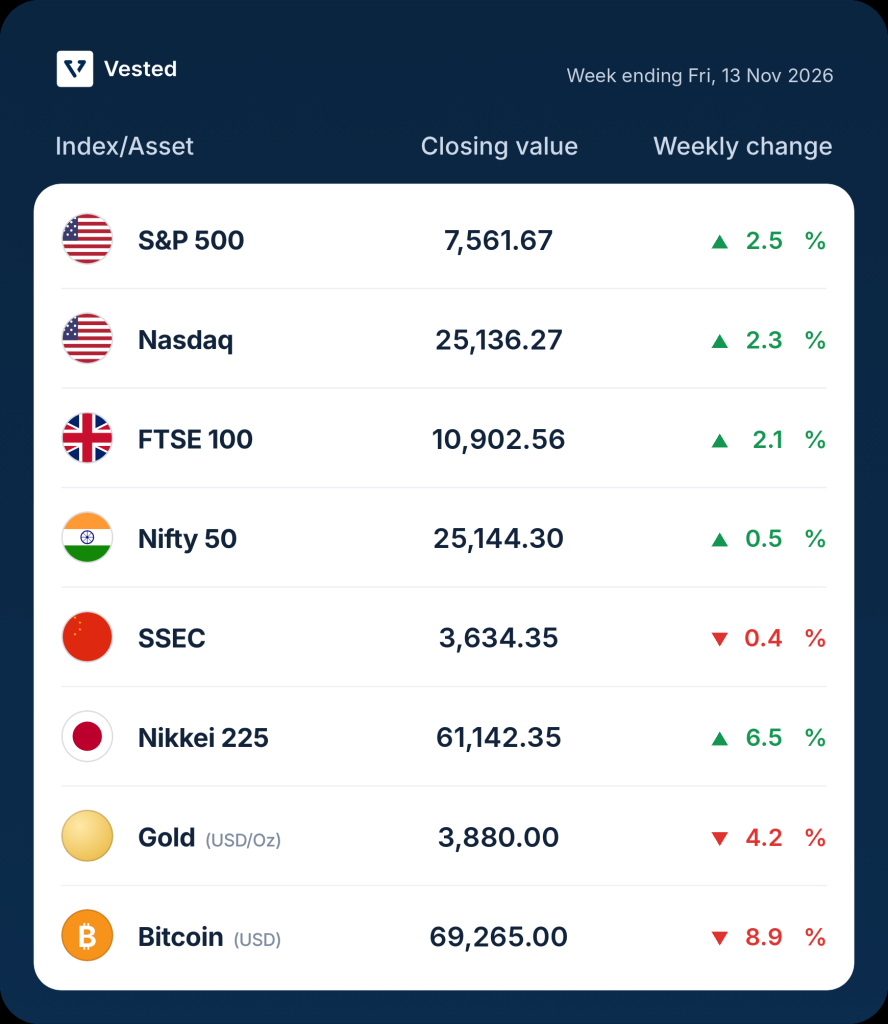
Stocks rose anyway. The S&P 500 gained 2.5% to 7,561.67 and the Nasdaq rose 2.3% to 25,136.27, its best week since August.
The mood turned on Thursday when Jensen Huang stepped down as Nvidia’s chief executive. Chip stocks fell hard on Friday, and the slide reached China, where the SSEC slipped 0.4% to 3,634.35.
Japan’s Nikkei 225 still ended the week up 6.5%, and the FTSE 100 rose 2.1% to a three-month high on energy and healthcare stocks.
Rate hike bets hit assets that pay nothing to hold. Gold fell about 4% and Bitcoin dropped about 9%, below $70,000. Brent crude swung between peace hopes and attack reports and ended near $95.5, its second weekly fall.
India held up. Foreign investors bought every day and the Nifty 50 rose 0.5% to 25,144.30.
But retail inflation at 6.09% is above the RBI’s comfort limit, and the rupee sits near 94.2 to the dollar, so every barrel of imported oil still costs more in rupees.
Now, moving to the week’s stories.
News Stories
The Domino Effect of Nvidia story
On Thursday, Jensen Huang resigned from Nvidia, 33 years after he co-founded it.
Its stock fell 11% between last Friday and Thursday, to $166.19, wiping out roughly $490 billion of value.
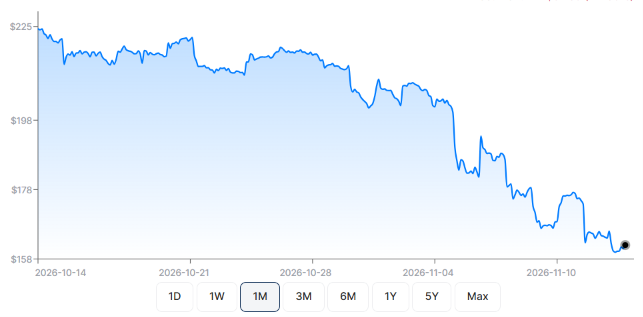
Source: NVDA on Vested app
You have probably read why. That’s not what we want to talk about. This story is about who else felt it, because very few companies sit at the centre of as much money as Nvidia.
First, its customers. Nvidia invested about $2 billion each in CoreWeave and Nebius, two companies that rent out its chips. On Thursday, Nebius fell 16.8% after also trimming its forecast, and CoreWeave fell 6.9%.
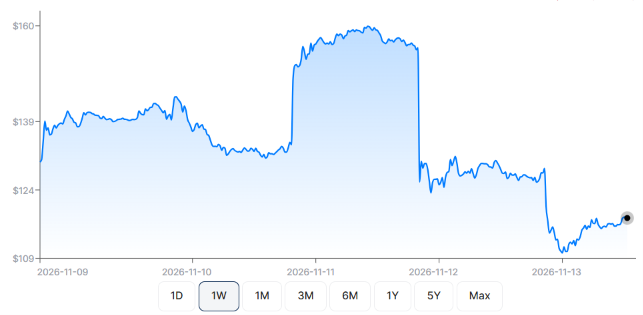
Source: NBIS on Vested app
It also guarantees up to $105 billion of payments on a giant AI data centre campus in Ohio, built for OpenAI. Hold on to that one for our next story.
Then its suppliers. Nvidia is now TSMC’s biggest customer, at about 19% of its sales last year.
It reportedly buys about two-thirds of its newest memory chips from SK hynix, which lost about $21 billion of value on Friday.
A Taiwan supplier executive told Reuters –
“We will support whatever capacity Nvidia needs, but the new CEO may not be as aggressive as Jensen.”
Word has it, keyman risk is real.
Then its lenders. The cost of insuring Nvidia’s own debt against default has more than tripled since mid-year, according to Bloomberg.
Then, its rivals. On Thursday, AMD rose 5.9% and Broadcom 5.5%.
There’s one caveat though. Nvidia’s products for the next year or two are already built. Armina Rosenberg of Minotaur Capital put it simply –
“The chips Nvidia will ship over the next year or two are already designed and in production.”
What can change is how freely Nvidia keeps funding its customers.
And finally, above all, its investors. We would refrain from the speculation about what happens to Nvidia stock next. But this does tell a lot about the importance of diversification.
No company, however good it may be, is guaranteed to remain that way all the time. As a prudent investor, you should always diversify your portfolio.
Anyways, Nvidia’s first results without Huang come on Tuesday. Let’s see what it holds.
We covered what Nvidia is worth without Huang in detail on our latest blog: Is Nvidia Still Worth $4 Trillion Without Jensen Huang?
SoftBank lost $3.7B on a data centre built for OpenAI
SoftBank is the Japanese group that has put almost $65 billion into OpenAI, the maker of ChatGPT.
On Tuesday, it reported a net loss of ¥1.12 trillion, about $7.1 billion, for July to September.
Analysts had expected a profit of about ¥129 billion. It is SoftBank’s first loss in almost two years.
| SoftBank (July – Sept’26) | Amount |
| Net result | ¥1.12 trillion loss (about $7.1B) |
| What analysts expected | ¥129 billion profit |
| Write-off on US power equipment | ¥597 billion (about $3.7B) |
| Interest costs (April to Sept) | ¥676 billion (up 151%) |
Source: SoftBank Group Q2 FY2026 report
The biggest hit was a $3.7 billion write-off on power equipment for AI data centres in the US.
Worried about a shortage, SoftBank had booked more gas turbines than its planned Ohio campus would need. When it cancelled the extra orders, it lost the money it had paid in advance.
That Ohio campus is the one OpenAI is leasing, and the same one Nvidia guarantees up to $105 billion of payments on.
A SoftBank executive explained the bet –
“We made bridge investments in advance to secure power generation equipment in anticipation of shortage.”
The second cost is quieter. SoftBank’s interest costs for April to September more than doubled from a year earlier, to ¥676 billion.
Investors did not like it. The stock fell as much as 11% in Tokyo on Wednesday, and another 5.1% on Friday.
It is now more than 50% below its June record.
Anthropic’s IPO is six times oversubscribed, already
Anthropic plans to list on the Nasdaq on 19 November under the ticker “ANT”.
It is selling 825 million shares at $70 to $78 each, to raise up to $64.4 billion.
At the top of that range, it would be worth about $1.4 trillion.
On Friday, Bloomberg reported that investors had placed orders for about six times the shares on offer.
| Anthropic IPO | Detail |
| Shares on offer | 825 million |
| Price range | $70 to $78 a share |
| Money raised | Up to $64.4 billion |
| Value at the top of the range | About $1.4 trillion |
| Demand | About 6x the shares on offer |
| Listing | 19 November, Nasdaq, ticker ANT |
Source: Reuters, 13 Nov 2026
Some of Anthropic’s money also comes from inside the AI chain. It has lined up $26 billion of planned investment from seven tech companies, including Google, Microsoft and Nvidia.
Bankers have told investors that existing backers get priority, so new buyers may get fewer shares than they ask for.
Anthropic’s own filing is blunt about what it builds. It says AI systems could –
“[…] take harmful actions independently and at scale without human intervention.”
There’s one caveat though. The valuation sits below earlier talk of $2 trillion, and the IPO details, including demand, can still change before the shares start trading.
We covered it in detail on our blog on Anthropic IPO.
The bottom line
All three stories narrow down to one lesson.
Nvidia lost its founder, and suppliers, customers and lenders moved with it.
SoftBank bet big on the data centres built for OpenAI, and took a $3.7 billion hit on them.
Anthropic drew orders for six times its shares, with Nvidia, Google and Microsoft among its backers.
The common thread? All three lean on the same few companies.
Owning five AI stocks can still be one bet, if all five depend on the same few companies.
None of this means the AI boom is over. The chips for next year are already made.
So next time you check how spread out your portfolio is, ask one question:
If one company had a bad week, how much of your portfolio would feel it?
If the answer is “most or all of it”, Global Funds and Managed Portfolios are simple ways to spread your money wider.
Anyways, Nvidia reports its first results without Huang on Tuesday, and we will be here to tell you what changed.
Thanks for reading!