




Welcome back to a new edition.
If you love analysing market’s reaction to events, this earnings week is your whodunit.
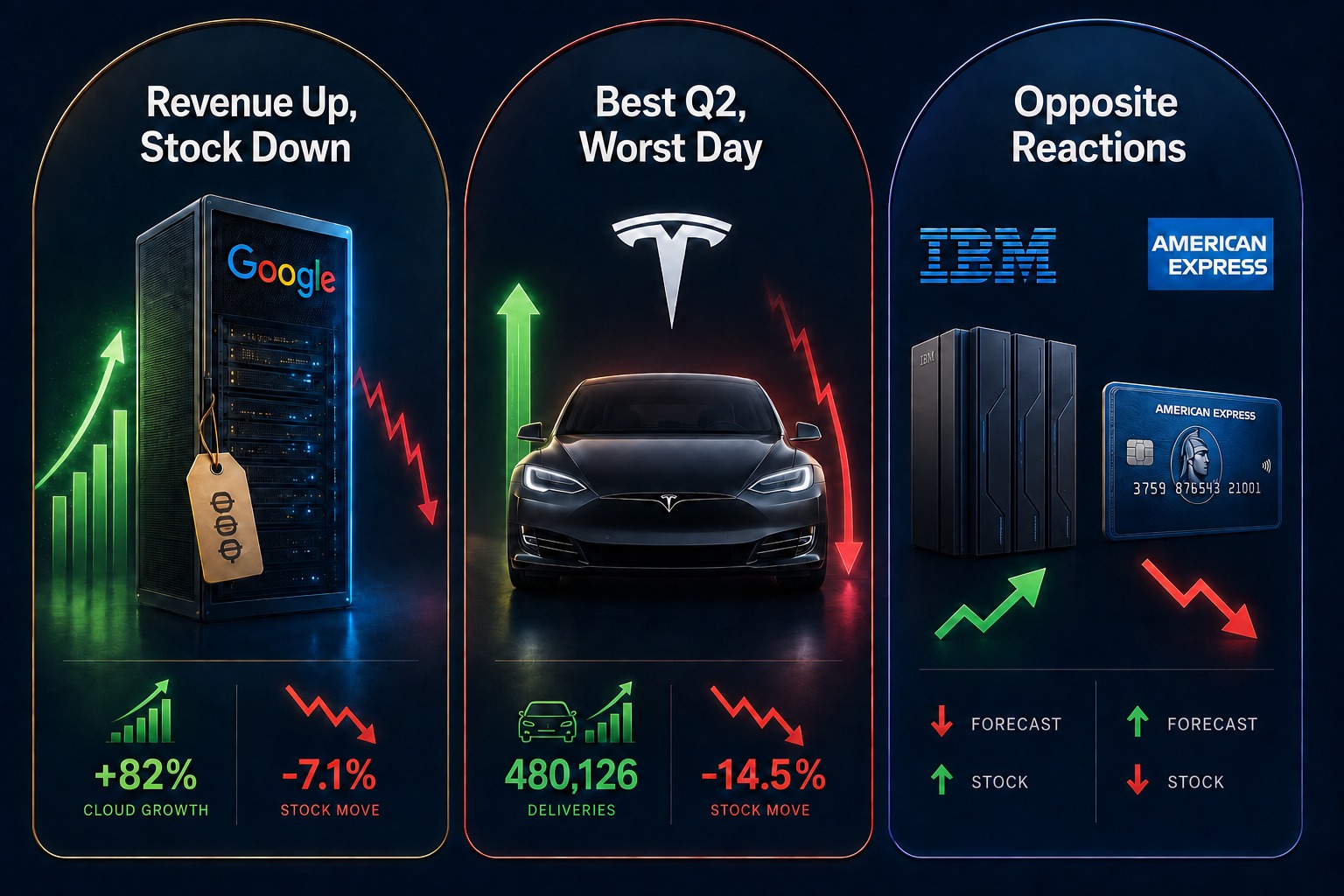
- Alphabet grew 24%. It fell.
- Tesla had its best-ever Q2 for deliveries. It crashed.
- IBM cut its forecast. It rose.
- Amex raised its forecast. But nothing.
The kicker: more US companies raised forecasts than at any time since 2011, and profits are expected to grow 26%.

The best guidance season on record, and you’ll see that markets didn’t quite buy it.
On Thursday alone, America’s biggest tech stocks lost nearly $800 billion.
Is that what happens when hopes do the pricing?
We’ll get to the interesting bits.
But, first things first, let’s see how the rest of the world held up this week.
The World in a Week: How Major Markets Moved
The Nasdaq ended the week down 2.13%, the S&P 500 down 0.61%, and the Nifty 50 down 2.33% after five straight losing sessions.
The trigger: crude crossed $100 a barrel.
The FTSE 100, Shanghai, and the Nikkei still managed gains.
The tell of the week: at $100 oil, markets stop asking who is growing and start asking who can absorb a fuel bill.


News summaries
Google Cloud grew 82%, but bills rained harder
On July 22, Google’s parent Alphabet (NASDAQ: GOOG) reported a quarter most companies would frame on a wall.
Revenue rose 24% to $119.8 billion, beating expectations, powered by 82% growth in Google Cloud, which reached $24.77 billion with a $514 billion backlog of committed future work. Cloud is now about a fifth of Alphabet’s entire revenue.

CEO Sundar Pichai opened the call calling it “an amazing quarter.”
The market knew exactly what its test was. Before results, Janus Henderson Investors’ Jonathan Cofsky told Bloomberg’s Markets Daily –
“If it shows an acceleration in cloud and continued strength in search, that would give investors greater comfort with its spending and the overall return profile of the stock.”
Alphabet delivered both, then broke the third condition nobody had priced: it raised 2026 capital spending guidance to as much as $205 billion, a $200 billion midpoint, reportedly about six times what it spent in 2022.
The result: a 7.1% fall on Thursday, the worst day since May 7, 2025. Here is what is actually happening.
The quarter ran on negative free cash flow of $5.9 billion, and Alphabet raised $49.6 billion in stock plus $20.3 billion in bonds to fund the build-out. A company famous for printing cash is borrowing to build data centres.
Alphabet’s problem is not making money. It is what making money now costs.
And if you are wondering what that cost actually buys, we traced the whole machine, every business the money feeds, and dived deeper into Alphabet’s $400B AI ecosystem, all in our video at Global Markets by Vested.
Watch on YouTube
Tesla sold more cars, but made investors less money
Minutes after Alphabet on July 22, Tesla (NASDAQ: TSLA) posted its best sales story in a while.
Revenue rose 26% to $28.24 billion on a record 480,126 deliveries, far above the roughly 406,600 expected, and trailing twelve-month revenue crossed $100 billion for the first time.
Then came the profit line.
Adjusted earnings hit $0.33 per share against $0.51 expected, operating income fell 57% to $398 million, and operating margin shrank to 1.4%. Capital spending surged 142% to $5.79 billion and free cash flow swung to a $1.09 billion deficit.
The verdict: a 14.5% crash on July 23 to $319.69, the lowest close since August 5, 2025, and the biggest one-day fall since March 10, 2025.
And was down over 16% in a month.

Anyways, here is the part worth sitting with.
Elon Musk barely dwelt on cars. He told analysts –
“I think for a lot of people, they’re actually buying Tesla Full Self-Driving with a car attached, as opposed to a car with FSD.”
He spent the call on robotaxis, the Cybercab, and Optimus robots, a product he admitted has no existing supply chain.
Record deliveries, the thing Tesla was asked to do this quarter, barely mattered to the price. Investors were reading the spending lines to figure out what Tesla is becoming.
Think of a restaurant with its busiest quarter ever, whose owner spent all the earnings renovating three branches that have not opened. The regulars are happy. The lender is doing math.
The market did not punish Tesla for what it sold. It punished it for what it spent.
Not everyone agreed. As the stock fell 14.5%, institutions sold, while retail investors reportedly put $42 million net into Tesla, more than any other stock that day, per Vanda Research.
The sellers saw the numbers on the page: 1.4% margins, negative free cash flow, a robotaxi payday that has moved before.
The buyers saw what those numbers bought: Tesla’s biggest ever buildout, its own chips, and self-driving software so in demand that Musk says people buy it with a car attached.
Only the next few quarters settle it. If you want a seat at that argument, Tesla and 10,000+ US stocks are available directly on Vested.
IBM cut its forecast, Amex raised it. Both acted opposite.
If you read last week’s edition, you already knew half of IBM’s story.
A few days back, on July 14, IBM (NYSE: IBM) crashed 25% in a single day, its worst day since 1968, worse than Black Monday in 1987, erasing about $68 billion and closing at $217.07. The reason, as we unpacked then: customers rushed money into AI servers and memory chips before prices rose, and cut back on IBM’s software to pay for it.
So when the official results landed on July 22, the suspense was gone.
Revenue grew just 1% to $17.16 billion, and IBM lowered its 2026 forecast, with mainframe sales down 42%. The one fresh item was mildly positive: IBM raised its free cash flow outlook by about $1 billion.
And the stock? It rose after the closing bell, and closed the next day at $206.65, slightly above its pre-earnings close.
Then on July 24, American Express (NYSE: AXP) reported the opposite: earnings of $4.53 per share, up 11% and above estimates, card spending up 9%, and a raised full-year revenue outlook of 10% growth.
CEO Stephen Squeri put it this way –
“Six months into the year, we’re seeing stronger momentum than we expected.”
The stock slipped about 1.4% in premarket trading, and dropped 6% during the day.
Here is what actually happened if you look at both the stocks.
Markets do not pay for good or bad. They pay for surprise, and IBM’s bad news was fully paid for on July 14, so the confirmation cost nothing. Amex beats so routinely that a beat is the expectation, a typical case of “buy the rumour, sell the news.”
Good news, bad news, old news: the market only pays for surprise.
Which is the quiet problem with headline investing. By the time news reaches you, the price has usually factored it already.
If you would rather not run that race stock by stock, Vested’s Managed Portfolios leave the reacting to professionals.
Invest in Managed Portfolios
Private Markets Pulse
Every story this week was a public company paying for its AI ambitions in advance. Here is the other side of that trade: two private companies building the same future, both open right now on Vested’s Private Markets:
- Figure AI
Builds humanoid robots that already run real shifts at a BMW plant, working daily 10-hour shifts over 11 months and handling 90,000+ parts. The company says it now runs more robots than humans internally. Last valued at $39 Bn, it is backed by NVIDIA, Microsoft, OpenAI’s startup fund, Jeff Bezos, and many more.
Explore Figure AI
- Whoop
This is the screenless black band you have seen on Virat Kohli, Ronaldo and LeBron. It gives the hardware away and charges a yearly subscription to read your sleep, strain and recovery, which is why it is priced like software, not a gadget. Over 2.5 Mn members, bookings up 103% in 2025, and cash-flow positive at a $1.1 Bn revenue run-rate. Its last private round drew Qatar’s QIA, Abu Dhabi’s Mubadala, plus Abbott and the Mayo Clinic, medical names that do not invest in fitness trackers. Founder Will Ahmed has reportedly said he expects it to be the last round before an IPO.
Explore Whoop
This week’s pick from GlobEd
This was a week when winners stopped winning. The Magnificent Seven, the market’s biggest momentum trade, lost nearly $800 billion in a day.
Weeks like this are exactly why momentum investors follow rules, not emotions.
In our next GlobEd Live Session, Alok Jain, founder of WeekendInvesting and an IIT Delhi alumnus with 30+ years in the markets, walks through that rulebook for US stocks: how to spot stocks with strong upward trends.